Pricing Study. Van Westendorp's price sensitivity model, ready to launch in two minutes.

Four questions. Real consumers from your target market. An acceptable price range, an optimal price point, and the ceiling above which buyers walk away. From $0.73/response.

30M+ panel · 127 countries · From $0.73/response

30M+ panel · 127 countries · From $0.73/response

What a Van Westendorp pricing study tells you

What a Van Westendorp pricing study tells you

What a Van Westendorp pricing study tells you

Asking people "how much would you pay?" is unreliable. People don't know — and even if they did, they'd anchor low. The Van Westendorp Price Sensitivity Meter asks four different questions that map the edges of acceptable pricing instead.

The acceptable price range

The window between your floor (below which quality seems suspect) and your ceiling (above which buyers walk away). Your pricing strategy has to live inside this range to be viable.

The optimal price point (OPP)

The price where equal numbers find your product "too cheap" and "too expensive." It minimizes total price resistance — objections from both ends of the spectrum balance out. This is usually your best opening price.

The indifference price point (IDP)

The price that feels "normal" in your category — where equal numbers find it cheap and expensive. This is what the market expects to pay. Pricing at IDP is safe but leaves money on the table.

Your pricing ceiling

The price above which too many buyers are lost. This is your hard upper bound — cross it and conversion drops materially.

Who runs Van Westendorp pricing studies

Who runs Van Westendorp pricing studies

Who runs Van Westendorp pricing studies

Who runs Van Westendorp pricing studies

about to set a price for the first time. Before you anchor to a number that sticks, find out what the market will actually accept. Changing a price after launch is hard; changing it in research costs a few hundred dollars.

Product teams

evaluating a price increase. Before you move price up, run a pricing study to confirm you're still inside the acceptable range — and that the ceiling hasn't moved since you last checked.

Brand managers

who've been pricing on gut feel and want to validate with data before their next funding round or distribution push.

Founders

delivering pricing recommendations to clients. A Van Westendorp study gives you the numbers that back up the recommendation.

Agencies and consultants

How it works

BG

Set your audience.

Target consumers who match your buyer profile — category purchasers, the right demographics, the right geography. The pricing study should survey the people who would actually buy your product, not the general population.

BG

Launch the study.

The Pricing Study template has the four Van Westendorp questions pre-built in the correct order, with a screener to filter qualified respondents and an attention check to protect data quality. Under 2 minutes from template to live.
BG

Collect responses.

The panel delivers completed responses from 30M+ verified respondents. Cost confirmed before launch. A standard pricing study needs 150–400 respondents to produce stable intersection curves.
BG

Read your results.

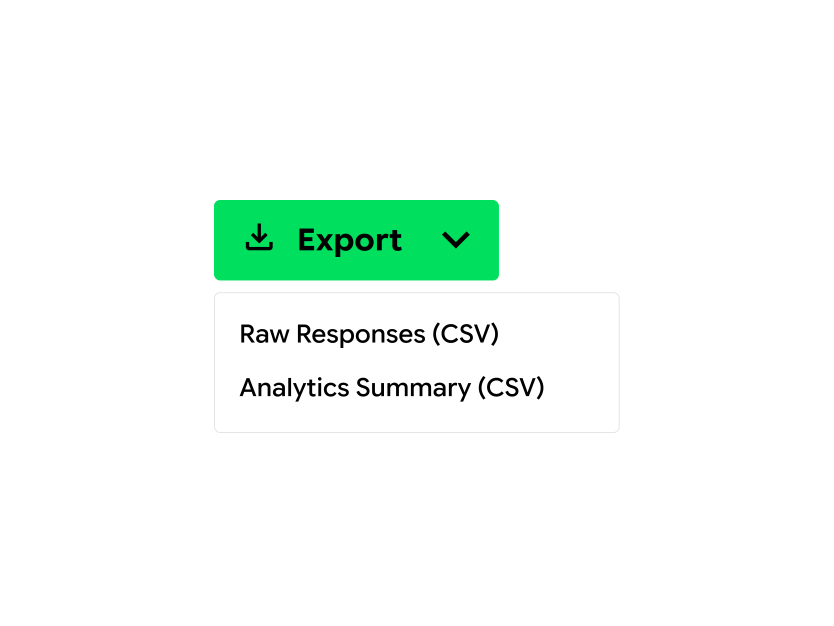
Export your four columns of price data and run them through the Van Westendorp Calculator → — or export to your own analysis. The calculator gives you PMC, IDP, OPP, PME, and the acceptable price range instantly.

Why four questions instead of one: a single "what would you pay?" question anchors respondents to a single number and systematically underestimates willingness to pay. The four-question PSM design maps the entire acceptable range and produces the specific intersection points you need to make a pricing decision.


A standard pricing study with 300 respondents in a B2C category runs approximately $220–$300 in panel costs. At 300 respondents, you have enough data for stable intersection curves and reliable price points.


Launch your pricing study → [Start free — no credit card required]
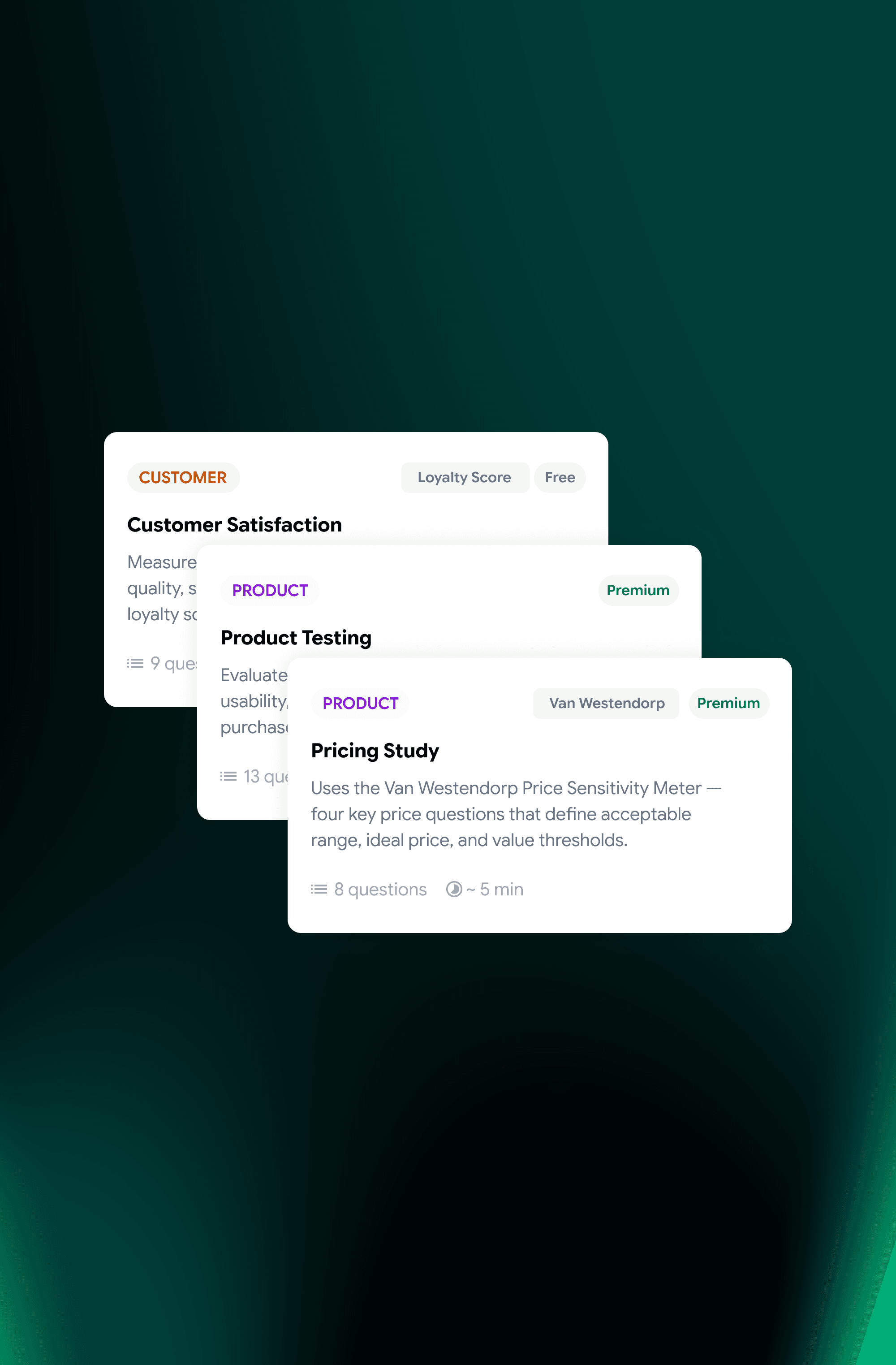
What's in the Pricing Study template

The template runs 6 questions — screener, four PSM questions, attention check. Clean, fast, high completion rate.

Screener"Which of the following best describes your relationship with [product category]?" Filters to category buyers or decision-makers for the product being priced.

Q1 — Too Cheap"At what price would [product] be so cheap that you'd question the quality?" Enter a price. The lower cheapness threshold.

Q2 — Good Value"At what price would [product] feel like a bargain — genuinely good value for what it is?" Enter a price. Not the ideal price — the floor of perceived value.

Q3 — Getting Expensive"At what price would [product] start to feel expensive, but you'd still consider buying it?" Enter a price. The onset of resistance.

Q4 — Too Expensive"At what price would [product] be too expensive — you'd definitely not buy it at that price?" Enter a price. The hard ceiling.

Attention check — Built in, auto-disqualifies inattentive respondents before their price entries reach your data.

Template available on the Pro plan ($79/month). Results pair directly with the free Van Westendorp Calculator → — no additional software required.

Esteban Corrales, Chief Analytics Officer of SegmentOS.

What's in the Pricing Study template

The template runs 6 questions — screener, four PSM questions, attention check. Clean, fast, high completion rate.

Screener"Which of the following best describes your relationship with [product category]?" Filters to category buyers or decision-makers for the product being priced.

Q1 — Too Cheap"At what price would [product] be so cheap that you'd question the quality?" Enter a price. The lower cheapness threshold.

Q2 — Good Value"At what price would [product] feel like a bargain — genuinely good value for what it is?" Enter a price. Not the ideal price — the floor of perceived value.

Q3 — Getting Expensive"At what price would [product] start to feel expensive, but you'd still consider buying it?" Enter a price. The onset of resistance.

Q4 — Too Expensive"At what price would [product] be too expensive — you'd definitely not buy it at that price?" Enter a price. The hard ceiling.

Attention check — Built in, auto-disqualifies inattentive respondents before their price entries reach your data.

Template available on the Pro plan ($79/month). Results pair directly with the free Van Westendorp Calculator → — no additional software required.

What's in the Pricing Study template

The template runs 6 questions — screener, four PSM questions, attention check. Clean, fast, high completion rate.

Screener"Which of the following best describes your relationship with [product category]?" Filters to category buyers or decision-makers for the product being priced.

Q1 — Too Cheap"At what price would [product] be so cheap that you'd question the quality?" Enter a price. The lower cheapness threshold.

Q2 — Good Value"At what price would [product] feel like a bargain — genuinely good value for what it is?" Enter a price. Not the ideal price — the floor of perceived value.

Q3 — Getting Expensive"At what price would [product] start to feel expensive, but you'd still consider buying it?" Enter a price. The onset of resistance.

Q4 — Too Expensive"At what price would [product] be too expensive — you'd definitely not buy it at that price?" Enter a price. The hard ceiling.

Attention check — Built in, auto-disqualifies inattentive respondents before their price entries reach your data.

Template available on the Pro plan ($79/month). Results pair directly with the free Van Westendorp Calculator → — no additional software required.

Esteban Corrales, Chief Analytics Officer of SegmentOS.

Simple pricing. No surprise invoices.

One subscription. Survey builder, panel access, and research-grade methodology all included.

One subscription. Survey builder, panel access, and research-grade methodology all included.

Free

$0

5 surveys (lifetime)

500 responses/month

4 templates

Standard question types

Basic analytics

Restricted question library access

/month

$

29

Unlimited surveys

All 17 templates

All question types

Multi-language (27 languages)

Scoring & quotas

Remove branding

Full CSV/XLSX export

Full access to our question library

Pro

/month

$

79

Everything in Premium

Audience panel access

White-label

Priority support

Panel Responses from $0.73

B2C consumer responses from $0.73/response. B2B professional responses priced by targeting criteria. Exact cost shown before you launch — always.


No annual contract required. Cancel anytime.

Free

$0

5 surveys (lifetime)

500 responses/month

4 templates

Standard question types

Basic analytics

Restricted question library access

/month

$

29

Unlimited surveys

All 17 templates

All question types

Multi-language (27 languages)

Scoring & quotas

Remove branding

Full CSV/XLSX export

Full access to our question library

Pro

/month

$

79

Everything in Premium

Audience panel access

White-label

Priority support

Panel Responses from $0.73

B2C consumer responses from $0.73/response. B2B professional responses priced by targeting criteria. Exact cost shown before you launch — always.


No annual contract required. Cancel anytime.

Free

$0

5 surveys (lifetime)

500 responses/month

4 templates

Standard question types

Basic analytics

Restricted question library access

/month

$

29

Unlimited surveys

All 17 templates

All question types

Multi-language (27 languages)

Scoring & quotas

Remove branding

Full CSV/XLSX export

Full access to our question library

Pro

/month

$

79

Everything in Premium

Audience panel access

White-label

Priority support

Panel Responses from $0.73

B2C consumer responses from $0.73/response. B2B professional responses priced by targeting criteria. Exact cost shown before you launch — always.


No annual contract required. Cancel anytime.

Common questions

What is Van Westendorp price sensitivity research?

The Van Westendorp Price Sensitivity Meter is a quantitative pricing research methodology developed by Dutch economist Peter van Westendorp in 1976. It uses four questions to map the edges of acceptable pricing for a product — not just a single "willingness to pay" number. The four questions produce cumulative frequency curves whose intersection points define key price thresholds: the floor, the indifference price, the optimal price, and the ceiling. It's one of the most widely used pricing research methods in market research, applied in brand studies, product pricing, and subscription pricing.

How many respondents do I need?

150 respondents produces usable intersection curves. 300 respondents gives you tighter confidence intervals and more stable points — especially useful when you're making a significant pricing decision. Above 500, you're getting diminishing returns. For a first pricing study, 200–300 respondents is the practical sweet spot: reliable results without over-investing in a single study. Use our sample size calculator → to dial in the right number.

What's the difference between Van Westendorp and conjoint analysis for pricing?

Van Westendorp isolates price as the only variable — it tells you what range the market will accept for the product as described. Conjoint analysis tests how respondents trade off price against specific features — it tells you the incremental willingness to pay for each feature and how price interacts with product configuration. Use Van Westendorp when you need to set or validate a price for a defined product. Use conjoint when you're making feature decisions alongside pricing and need to see the trade-off between them.

Can I test multiple price points or product variants?

The Van Westendorp methodology tests one product at a time. Each respondent answers four questions about a single product description at whatever price comes to mind — there are no price points shown to the respondent. If you want to test two product variants (different feature sets, different brand names, different packaging), you run each as a separate study using a monadic design: each respondent sees only one variant. Showing both to the same respondent creates anchoring effects that compromise the data.

What do I do with the results?

Export your four columns of responses and run them through the Van Westendorp Calculator →. The calculator produces your acceptable price range, OPP, IDP, and PME. From there: the OPP is usually your best opening price. Check whether your current or planned price sits inside the acceptable range. Compare OPP to your unit economics — if the OPP doesn't support your margin, you have a cost problem, not a pricing problem. And look at the width of the acceptable range: a narrow range means price-sensitive buyers; a wide range means real pricing latitude.

Is this the same methodology agencies use?

Yes. The Van Westendorp PSM is standard in professional market research — used by brand consultancies, pricing consultants, and product teams at large consumer brands. The same methodology that research agencies charge $5,000–$15,000 per study for is available here as a self-serve template. The questions, the cumulative frequency methodology, and the intersection point calculation are identical.

Related

Related

process your results instantly (free tool)


Van Westendorp Calculator

process your results instantly (free tool)


Van Westendorp Calculator

how many respondents for a pricing study?

Sample Size Calculator

how many respondents for a pricing study?

Sample Size Calculator


SegmentOS vs. Pollfish


SegmentOS vs. Pollfish

why feedback tools aren't built for brand research

SegmentOS vs. SurveyMonkey

why feedback tools aren't built for brand research

SegmentOS vs. SurveyMonkey