Loyalty Score Survey Template. Measure loyalty, diagnose the drivers, benchmark over time.

A 5-question recurring loyalty study built around Loyalty Score — with the follow-up questions that tell you why the score is what it is, not just what it is. Works for customer LS and employee LS (eLS). Launch in under 2 minutes.

30M+ panel · 127 countries · From $0.73/response

30M+ panel · 127 countries · From $0.73/response

What a loyalty score survey measures

What a loyalty score survey measures

What a loyalty score survey measures

Loyalty Score

The single-question loyalty metric: "How likely are you to recommend [brand/product/company] to a friend or colleague?" Scored 0–10. Promoters (9–10), Passives (7–8), Detractors (0–6). LS = % Promoters − % Detractors. Industry-standard benchmark for brand and product loyalty.

Aided awareness

LS tells you the score. Driver questions tell you why — what specifically is earning or eroding loyalty. Understanding drivers is what makes LS actionable: without them, you know you have a 32 LS and nothing to fix.

Promoter vs. detractor verbatims

Open-text follow-up questions capture qualitative explanation in the respondents' own words. What do Promoters love? What are Detractors upset about? The verbatim responses are often the most useful output of the entire study.

eLS (Employee LS)

The same 0–10 scale applied to employees: "How likely are you to recommend [company] as a place to work?" Measures employee loyalty and advocacy — a leading indicator of retention and culture health.

Who runs LS surveys

Who runs LS surveys

Who runs LS surveys

Who runs LS surveys

tracking customer loyalty over time and benchmarking LS against industry averages.

CX and marketing teams

running LS after feature releases to measure whether changes improved loyalty or introduced friction.

Product teams

who want to understand whether brand perception drives promoter behavior — and which associations are most predictive of recommendation.

Brand managers

measuring eLS as part of employee satisfaction tracking — a faster pulse check than a full employee satisfaction survey.

HR teams

at agencies delivering LS benchmarking studies across competitive sets for clients.

Research teams

How it works

BG

Set your audience.

For customer LS: target recent buyers or existing customers in your category. For eLS: target employees at companies matching your industry and size profile. For competitive benchmarking: target users of specific competitor products.

BG

Launch the study.

The Loyalty Score template has the LS question, driver follow-ups, and open-text verbatim questions pre-built. Customize the brand or product name, set your sample size, and launch.
BG

Collect responses.

Panel delivers in as little 48 hours. For recurring LS tracking, SegmentOS lets you relaunch the same study at your chosen interval — monthly, quarterly, or annually — so results are directly comparable wave-over-wave.
BG

Read your results.

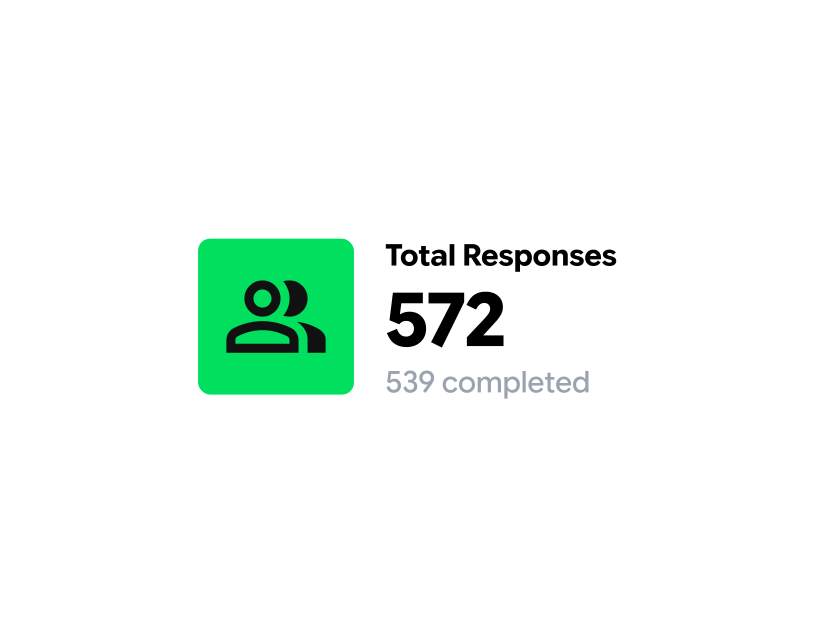
LS score with Promoter / Passive / Detractor breakdown, driver question distributions, word cloud from verbatim responses, and trend line if you're tracking over time.

Launch your loyalty score survey → [Start free — no credit card required]

What's in the Loyalty Score template

The template runs 5 core questions, expandable to 8–10 with driver questions:

Screener"Have you purchased from / used [brand or product] in the last 6 months?" Qualifies respondents as actual customers, not general population.

LS question"On a scale of 0 to 10, how likely are you to recommend [brand/product] to a friend or colleague?" 0–10 scale. Loyalty Score (LS scale) question type.

Driver question (Promoters)"What's the main reason for your score?" Multiple choice, shown only to 9–10 respondents. Pre-loaded with common promoter drivers: product quality, price, customer service, ease of use, reliability, brand trust.

Driver question (Detractors) — Same structure, shown only to 0–6 respondents. Pre-loaded with common detractor drivers: price too high, poor customer service, product issues, better alternatives available.

Verbatim"Is there anything else you'd like to share about your experience?" Open text. Applies to all respondents.

Attention check — built in, auto-disqualifies inattentive respondents.

Template available on Pro plan ($79/month). Free plan includes 4 templates.

Esteban Corrales, Chief Analytics Officer of SegmentOS.

What's in the Loyalty Score template

The template runs 5 core questions, expandable to 8–10 with driver questions:

Screener"Have you purchased from / used [brand or product] in the last 6 months?" Qualifies respondents as actual customers, not general population.

LS question"On a scale of 0 to 10, how likely are you to recommend [brand/product] to a friend or colleague?" 0–10 scale. Loyalty Score (LS scale) question type.

Driver question (Promoters)"What's the main reason for your score?" Multiple choice, shown only to 9–10 respondents. Pre-loaded with common promoter drivers: product quality, price, customer service, ease of use, reliability, brand trust.

Driver question (Detractors) — Same structure, shown only to 0–6 respondents. Pre-loaded with common detractor drivers: price too high, poor customer service, product issues, better alternatives available.

Verbatim"Is there anything else you'd like to share about your experience?" Open text. Applies to all respondents.

Attention check — built in, auto-disqualifies inattentive respondents.

Template available on Pro plan ($79/month). Free plan includes 4 templates.

Esteban Corrales, Chief Analytics Officer of SegmentOS.

What's in the Loyalty Score template

The template runs 5 core questions, expandable to 8–10 with driver questions:

Screener"Have you purchased from / used [brand or product] in the last 6 months?" Qualifies respondents as actual customers, not general population.

LS question"On a scale of 0 to 10, how likely are you to recommend [brand/product] to a friend or colleague?" 0–10 scale. Loyalty Score (LS scale) question type.

Driver question (Promoters)"What's the main reason for your score?" Multiple choice, shown only to 9–10 respondents. Pre-loaded with common promoter drivers: product quality, price, customer service, ease of use, reliability, brand trust.

Driver question (Detractors) — Same structure, shown only to 0–6 respondents. Pre-loaded with common detractor drivers: price too high, poor customer service, product issues, better alternatives available.

Verbatim"Is there anything else you'd like to share about your experience?" Open text. Applies to all respondents.

Attention check — built in, auto-disqualifies inattentive respondents.

Template available on Pro plan ($79/month). Free plan includes 4 templates.

LS survey software — what makes research-grade LS different

LS survey software — what makes research-grade LS different

LS survey software — what makes research-grade LS different

A basic NPS question in a free form tool gives you a score. SegmentOS gives you the score, the drivers, the verbatims, and a panel to field to if you're benchmarking against the market rather than surveying your own customer list.

Key differences from a standard feedback tool:


Panel access. Survey your own customers or buy responses from the 30M+ panel — useful for competitive NPS benchmarking (how does your NPS compare to competitors?) without needing access to their customer lists.


Screener-enforced audience quality. Only actual customers or category users answer the NPS question. General population NPS scores are meaningless — the screener keeps the sample clean.


Recurring study design. The same question wording, same scale, same audience definition across every wave. Consistent methodology is what makes trend data valid.


Driver diagnostics. Not just the score — the reasons behind it. The Promoter and Detractor driver questions turn a single number into an action plan.

A basic NPS question in a free form tool gives you a score. SegmentOS gives you the score, the drivers, the verbatims, and a panel to field to if you're benchmarking against the market rather than surveying your own customer list.

Key differences from a standard feedback tool:


Panel access. Survey your own customers or buy responses from the 30M+ panel — useful for competitive NPS benchmarking (how does your NPS compare to competitors?) without needing access to their customer lists.


Screener-enforced audience quality. Only actual customers or category users answer the NPS question. General population NPS scores are meaningless — the screener keeps the sample clean.


Recurring study design. The same question wording, same scale, same audience definition across every wave. Consistent methodology is what makes trend data valid.


Driver diagnostics. Not just the score — the reasons behind it. The Promoter and Detractor driver questions turn a single number into an action plan.

Simple pricing. No surprise invoices.

One subscription. Survey builder, panel access, and research-grade methodology all included.

One subscription. Survey builder, panel access, and research-grade methodology all included.

Free

$0

5 surveys (lifetime)

500 responses/month

4 templates

Standard question types

Basic analytics

Restricted question library access

/month

$

29

Unlimited surveys

All 17 templates

All question types

Multi-language (27 languages)

Scoring & quotas

Remove branding

Full CSV/XLSX export

Full access to our question library

Pro

/month

$

79

Everything in Premium

Audience panel access

White-label

Priority support

Panel Responses from $0.73

B2C consumer responses from $0.73/response. B2B professional responses priced by targeting criteria. Exact cost shown before you launch — always.


No annual contract required. Cancel anytime.

Free

$0

5 surveys (lifetime)

500 responses/month

4 templates

Standard question types

Basic analytics

Restricted question library access

/month

$

29

Unlimited surveys

All 17 templates

All question types

Multi-language (27 languages)

Scoring & quotas

Remove branding

Full CSV/XLSX export

Full access to our question library

Pro

/month

$

79

Everything in Premium

Audience panel access

White-label

Priority support

Panel Responses from $0.73

B2C consumer responses from $0.73/response. B2B professional responses priced by targeting criteria. Exact cost shown before you launch — always.


No annual contract required. Cancel anytime.

Free

$0

5 surveys (lifetime)

500 responses/month

4 templates

Standard question types

Basic analytics

Restricted question library access

/month

$

29

Unlimited surveys

All 17 templates

All question types

Multi-language (27 languages)

Scoring & quotas

Remove branding

Full CSV/XLSX export

Full access to our question library

Pro

/month

$

79

Everything in Premium

Audience panel access

White-label

Priority support

Panel Responses from $0.73

B2C consumer responses from $0.73/response. B2B professional responses priced by targeting criteria. Exact cost shown before you launch — always.


No annual contract required. Cancel anytime.

Common questions

What's a good LS score?

LS benchmarks vary significantly by industry. In consumer tech, a score above 30 is generally considered good; above 50 is excellent. In retail, average NPS tends to run 30–45. In financial services, 20–35 is typical. The more useful benchmark is your own historical NPS over time — is it improving, stable, or declining? — and the NPS of your direct competitors measured in the same study.

How is this different from a basic NPS calculator?

A calculator converts a score into NPS arithmetic. This is a full study: screener to qualify respondents, NPS question, driver follow-ups to explain the score, verbatim capture, and optional panel to field to external audiences. The calculator is one output. The study produces the data that makes the calculator output actionable.

How often should I run an LS survey?

Quarterly is the standard for brand-level LS tracking. Monthly is appropriate during periods of significant product change or service disruption — you want to detect the impact quickly. Annual NPS is too slow to be actionable. For post-transaction NPS (after a specific purchase or service interaction), continuous fielding is the norm.

What's the difference between LS and CSAT?

LS measures long-term loyalty — whether someone would recommend you, which predicts retention and advocacy. CSAT (Customer Satisfaction Score) measures satisfaction with a specific experience or transaction. NPS is relationship-level; CSAT is transaction-level. For a complete picture of customer health, run both.

Can I measure eLS (employee LS) with this template?

Yes. Change the screener to qualify current employees, and change the LS question to "How likely are you to recommend [company] as a place to work?" The driver questions update to reflect common employee loyalty factors. eNPS benchmarks: above 10 is average for most industries; above 40 is excellent; below 0 means you have a retention problem.