Conjoint Analysis Study. See exactly which features your customers would pay more to keep.
Present real trade-offs between product configurations. Find which features drive purchase decisions, which ones don't matter, and what each one is worth in dollars. From $0.73/response.
Most product surveys ask people what they want. Conjoint analysis asks them to choose — which forces real trade-offs. The result is a hierarchy of what actually matters, not what people say matters.
Feature importance
Which attributes drive purchase decisions most? Speed, price, brand, warranty, material — conjoint quantifies how much each one influences choice. Not ranked by opinion, but revealed by actual decisions under trade-off conditions.
Willingness to pay per feature
How much is a 2-year warranty worth vs. a 1-year warranty? How much would consumers pay for next-day delivery vs. 3-day? Conjoint produces dollar estimates for each feature level — without asking anyone "how much would you pay for this?"
Optimal product configuration
Which combination of features maximizes purchase intent at your target price? You can simulate different configurations and see which one wins in the market.
Competitive simulation
How does your current or planned product perform against a competitor's configuration? Conjoint lets you model market share across configurations — including the competitor's.
How it works


Define your attributes and levels.
Before launching, you configure the study with the product attributes you want to test (e.g., price, speed, warranty, material) and the specific levels for each (e.g., price: $29 / $49 / $79). The template guides you through this setup.

Launch the study.
Respondents see a series of choice sets — each one presents two or three product configurations with different combinations of attribute levels. They pick the one they prefer. This process reveals how much each attribute and level matters relative to the others.
Collect responses.
150–300 respondents produce reliable utility estimates. The panel delivers from 30M+ verified respondents with demographic targeting. Screener and attention check included.
Read your results.
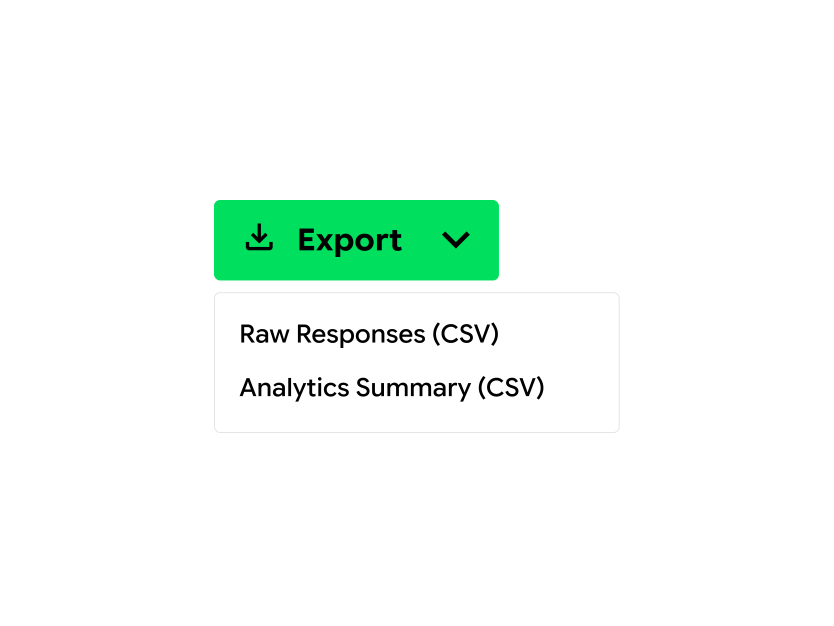
Export your conjoint data and run the analysis — utilities per attribute level, relative importance scores, and willingness-to-pay estimates. For teams running this internally for the first time, we recommend starting with a straightforward 3–4 attribute design before adding complexity.
Why trade-offs produce better data than rankings: when you ask someone to rank features in order of importance, they'll tell you everything is important. When you force them to choose between Product A (fast, no warranty, $49) and Product B (slower, 2-year warranty, $29), their choice reveals the actual trade-off they're willing to make. Conjoint is a forced-choice design by nature.
A standard conjoint study with 200 respondents runs approximately $150–$200 in panel costs. Most conjoint studies need 150–250 respondents per segment you want to analyze separately.
Launch your conjoint analysis study → [Start free — no credit card required]


Simple pricing. No surprise invoices.



Common questions
What is conjoint analysis in market research?
Conjoint analysis is a quantitative research method that measures how consumers value different product features by presenting them with trade-off scenarios. Instead of asking "what features do you want?" — which produces unreliable rankings — conjoint forces respondents to choose between complete product configurations. The choices reveal the relative importance of each feature and the dollar value respondents implicitly assign to each level. It's the standard methodology for feature prioritization, pricing research, and competitive product simulation.
How is conjoint analysis different from Van Westendorp pricing research?
Van Westendorp isolates price as the only variable — it tells you the acceptable price range for a product as described. Conjoint analysis tests how price interacts with features — it tells you how willingness to pay changes as you add or remove specific attributes. Use Van Westendorp when the product is defined and you need to set a price. Use conjoint when you're still deciding what the product is and need to understand which features justify which price levels.
How many attributes can I test?
A well-designed conjoint study tests 3–6 attributes with 2–4 levels each. Beyond 6 attributes, the choice tasks become cognitively demanding and response quality degrades. If you have a long list of features to evaluate, run a MaxDiff study first to narrow down which attributes matter most, then use conjoint to quantify the trade-offs between the finalists.
What's the difference between conjoint analysis and a simple feature ranking survey?
A feature ranking survey asks respondents to tell you what they value. Conjoint analysis reveals what they value through revealed preference — what they actually choose when forced to trade off. People consistently overstate the importance of quality, sustainability, and brand in direct ranking studies, and understate the influence of price. Conjoint corrects for this because respondents can't game a trade-off design the way they can game a ranking exercise.
Can I test a concept that doesn't exist yet?
Yes — that's the point. You present a written description of the concept: what the product is, what it does, the core benefit or differentiator. It doesn't need to be a working prototype or even a mockup. A clear, specific one-paragraph description is sufficient for respondents to evaluate. The clearer and more concrete your concept description, the more reliable the scores.
How many respondents do I need for conjoint analysis?
50–200 respondents is sufficient for a straightforward conjoint with 4–5 attributes. If you plan to segment results by demographic group (e.g., analyze men and women separately, or two geographic markets), multiply by the number of segments — you need 150–200 per segment. For a study analyzing 3 segments, that's 450–600 respondents total.