Customer Satisfaction Survey. CSAT, Loyalty Score, and Customer Effort Score — in one study.

Satisfaction by touchpoint, loyalty score, ease of experience, and the reason behind each rating — measured with real consumers from 127 countries or your own customer list. From $0.73/response.

30M+ panel · 127 countries · From $0.73/response

30M+ panel · 127 countries · From $0.73/response

What you learn from a customer satisfaction survey

What you learn from a customer satisfaction survey

What you learn from a customer satisfaction survey

Satisfaction isn't one number. It's the sum of what your customer experiences across every touchpoint — the product, the service, the price, and the effort it took to get what they needed. Four metrics the study measures:

CSAT — Customer Satisfaction Score

How satisfied is the customer with your product, service, or overall experience? The most direct satisfaction metric: ask, get a number, track it over time.

Loyalty Score

How likely is the customer to recommend your company to someone else? Scale of 0–10. Classifies customers into Promoters, Passives, and Detractors — and produces an index you can benchmark against industry standards.

CES — Customer Effort Score

How easy was it for the customer to solve their problem or complete their task? Effort predicts loyalty better than satisfaction in many contexts — especially in customer service and support.

Satisfaction drivers

What's behind the score? Product, price, support, delivery times, communication. Breaking satisfaction down by dimension tells you where to act.

What to look for in customer satisfaction survey software

What to look for in customer satisfaction survey software

What to look for in customer satisfaction survey software

Most customer satisfaction tools give you a rating scale and a results dashboard. Research-grade customer satisfaction survey software does more: it lets you combine CSAT, Loyalty Score, and CES in a single study, screen for the right respondents, run quality controls on every response, and reach consumers outside your existing customer list when you need market-level benchmarking.


SegmentOS includes all of this in one platform — the survey builder, the template, the panel, and the analytics. You build the study, set your audience, and launch. The quality controls — device fingerprinting, speeding detection, attention checks — run automatically on every response before you see it.


For studies to your own customer list: the Premium plan ($29/month) covers unlimited surveys and unlimited responses. For studies to external consumers or market benchmarking: the Pro plan ($79/month) includes access to 30M+ verified respondents across 127 countries, with demographic targeting built in.

Most customer satisfaction tools give you a rating scale and a results dashboard. Research-grade customer satisfaction survey software does more: it lets you combine CSAT, Loyalty Score, and CES in a single study, screen for the right respondents, run quality controls on every response, and reach consumers outside your existing customer list when you need market-level benchmarking.


SegmentOS includes all of this in one platform — the survey builder, the template, the panel, and the analytics. You build the study, set your audience, and launch. The quality controls — device fingerprinting, speeding detection, attention checks — run automatically on every response before you see it.


For studies to your own customer list: the Premium plan ($29/month) covers unlimited surveys and unlimited responses. For studies to external consumers or market benchmarking: the Pro plan ($79/month) includes access to 30M+ verified respondents across 127 countries, with demographic targeting built in.

Who runs customer satisfaction surveys

Who runs customer satisfaction surveys

Who runs customer satisfaction surveys

Who runs customer satisfaction surveys

measuring support performance, identifying friction points in the customer journey, and prioritizing improvements based on data rather than anecdote.

CX and customer service teams

who want to understand which aspects of the product generate satisfaction and which are stalling retention.

Product managers

who need to connect customer experience to loyalty and repurchase metrics — and show the impact to senior leadership.

Marketing directors

delivering CX reports to clients who want primary consumer data, not just review analysis or social sentiment.

Agencies

How it works

BG

Set your audience.

Current customers, recent buyers, or the consumer profile you want to benchmark against. For post-purchase CSAT surveys, distribute to your own customer list. For broader market studies, access the 30M+ panel.

BG

Launch the study.

The Customer Satisfaction template has CSAT, NPS, and CES questions pre-built with the right scale and follow-up logic configured. Add a screener if you need to filter by customer type or purchase experience. Under 2 minutes from template to live.
BG

Collect responses.

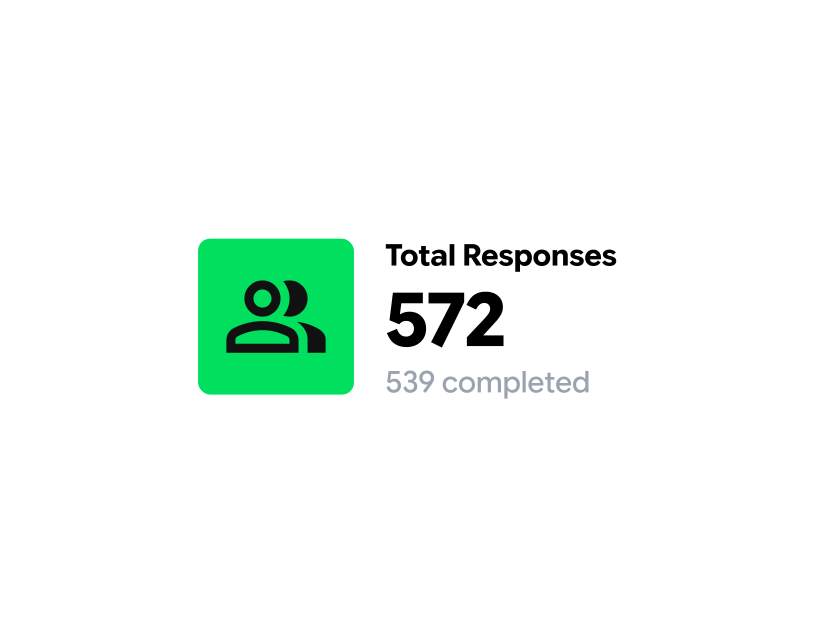
The panel delivers responses from 30M+ verified respondents. Cost confirmed before launch. Quality controls — device fingerprinting, speeding detection, attention checks — run automatically.
BG

Read your results.

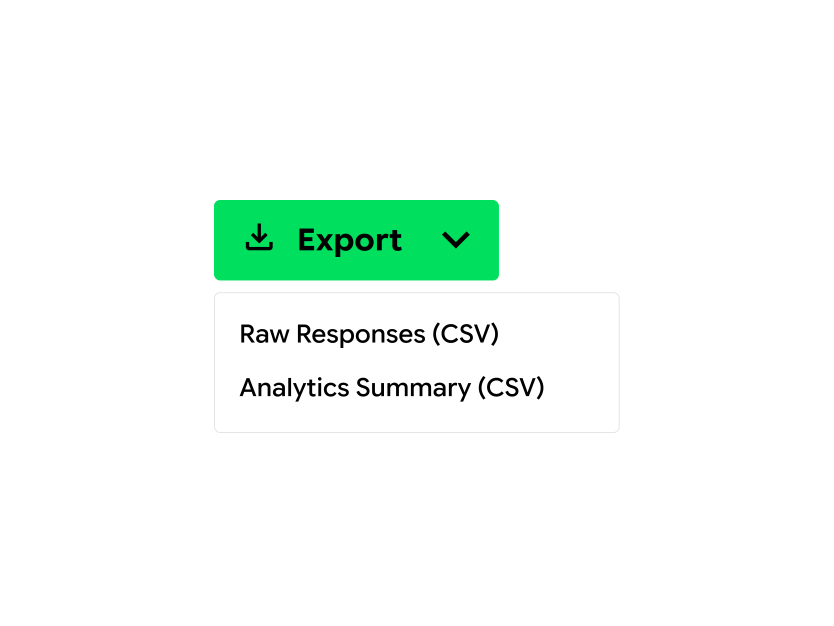
Per-question analytics, Loyalty Score breakdown by Promoters/Passives/Detractors, CSAT and CES scores with full distribution. Export as CSV or XLSX for deeper analysis or to feed your CX dashboard.

For a study to your own customer list, the cost is your monthly subscription — no panel charges. For a panel study with 300 external respondents in a B2C category, expect approximately $220–$300 in panel costs depending on targeting.


Launch your customer satisfaction study → [Start free — no credit card required]

What's in the Customer Satisfaction template

The template runs approximately 12 questions. Core structure:

Screener"Have you made a purchase from [company/category] in the last 3 months?" Filters out respondents who don't have recent experience with the product or service.

CSAT — overall satisfaction"Overall, how satisfied are you with [company/product]?" 5-point scale from Very dissatisfied to Very satisfied. Your headline satisfaction metric.

Satisfaction by dimension"How satisfied are you with each of the following aspects?" Grid with key dimensions: product quality, customer service, price-to-value ratio, ease of use, delivery time.

Loyalty Score"How likely are you to recommend [company] to a friend or colleague?" Scale of 0–10. Automatically classifies into Promoters (9–10), Passives (7–8), Detractors (0–6).

Loyalty Score follow-up"What's the main reason for your score?" Open text. The most valuable question in the study: it tells you why the customer is a Promoter or Detractor, not just that they are.

CES"How easy was it to [complete your purchase / resolve your issue / find what you were looking for]?" 7-point scale. Measures friction in the customer journey.

Attention check — Built in, auto-disqualifies inattentive respondents before their responses reach your results.

Template available on the Pro plan ($79/month). For distribution to your own customer list with unlimited responses, the Premium plan ($29/month) covers it — no per-response panel cost.

Esteban Corrales, Chief Analytics Officer of SegmentOS.

What's in the Customer Satisfaction template

The template runs approximately 12 questions. Core structure:

Screener"Have you made a purchase from [company/category] in the last 3 months?" Filters out respondents who don't have recent experience with the product or service.

CSAT — overall satisfaction"Overall, how satisfied are you with [company/product]?" 5-point scale from Very dissatisfied to Very satisfied. Your headline satisfaction metric.

Satisfaction by dimension"How satisfied are you with each of the following aspects?" Grid with key dimensions: product quality, customer service, price-to-value ratio, ease of use, delivery time.

Loyalty Score"How likely are you to recommend [company] to a friend or colleague?" Scale of 0–10. Automatically classifies into Promoters (9–10), Passives (7–8), Detractors (0–6).

Loyalty Score follow-up"What's the main reason for your score?" Open text. The most valuable question in the study: it tells you why the customer is a Promoter or Detractor, not just that they are.

CES"How easy was it to [complete your purchase / resolve your issue / find what you were looking for]?" 7-point scale. Measures friction in the customer journey.

Attention check — Built in, auto-disqualifies inattentive respondents before their responses reach your results.

Template available on the Pro plan ($79/month). For distribution to your own customer list with unlimited responses, the Premium plan ($29/month) covers it — no per-response panel cost.

What's in the Customer Satisfaction template

The template runs approximately 12 questions. Core structure:

Screener"Have you made a purchase from [company/category] in the last 3 months?" Filters out respondents who don't have recent experience with the product or service.

CSAT — overall satisfaction"Overall, how satisfied are you with [company/product]?" 5-point scale from Very dissatisfied to Very satisfied. Your headline satisfaction metric.

Satisfaction by dimension"How satisfied are you with each of the following aspects?" Grid with key dimensions: product quality, customer service, price-to-value ratio, ease of use, delivery time.

Loyalty Score"How likely are you to recommend [company] to a friend or colleague?" Scale of 0–10. Automatically classifies into Promoters (9–10), Passives (7–8), Detractors (0–6).

Loyalty Score follow-up"What's the main reason for your score?" Open text. The most valuable question in the study: it tells you why the customer is a Promoter or Detractor, not just that they are.

CES"How easy was it to [complete your purchase / resolve your issue / find what you were looking for]?" 7-point scale. Measures friction in the customer journey.

Attention check — Built in, auto-disqualifies inattentive respondents before their responses reach your results.

Template available on the Pro plan ($79/month). For distribution to your own customer list with unlimited responses, the Premium plan ($29/month) covers it — no per-response panel cost.

Esteban Corrales, Chief Analytics Officer of SegmentOS.

Simple pricing. No surprise invoices.

One subscription. Survey builder, panel access, and research-grade methodology all included.

One subscription. Survey builder, panel access, and research-grade methodology all included.

Free

$0

5 surveys (lifetime)

500 responses/month

4 templates

Standard question types

Basic analytics

Restricted question library access

/month

$

29

Unlimited surveys

All 17 templates

All question types

Multi-language (27 languages)

Scoring & quotas

Remove branding

Full CSV/XLSX export

Full access to our question library

Pro

/month

$

79

Everything in Premium

Audience panel access

White-label

Priority support

Panel Responses from $0.73

B2C consumer responses from $0.73/response. B2B professional responses priced by targeting criteria. Exact cost shown before you launch — always.


No annual contract required. Cancel anytime.

Free

$0

5 surveys (lifetime)

500 responses/month

4 templates

Standard question types

Basic analytics

Restricted question library access

/month

$

29

Unlimited surveys

All 17 templates

All question types

Multi-language (27 languages)

Scoring & quotas

Remove branding

Full CSV/XLSX export

Full access to our question library

Pro

/month

$

79

Everything in Premium

Audience panel access

White-label

Priority support

Panel Responses from $0.73

B2C consumer responses from $0.73/response. B2B professional responses priced by targeting criteria. Exact cost shown before you launch — always.


No annual contract required. Cancel anytime.

Free

$0

5 surveys (lifetime)

500 responses/month

4 templates

Standard question types

Basic analytics

Restricted question library access

/month

$

29

Unlimited surveys

All 17 templates

All question types

Multi-language (27 languages)

Scoring & quotas

Remove branding

Full CSV/XLSX export

Full access to our question library

Pro

/month

$

79

Everything in Premium

Audience panel access

White-label

Priority support

Panel Responses from $0.73

B2C consumer responses from $0.73/response. B2B professional responses priced by targeting criteria. Exact cost shown before you launch — always.


No annual contract required. Cancel anytime.

Common questions

What is CSAT and how is it calculated?

CSAT (Customer Satisfaction Score) is the proportion of customers who rate their experience as satisfactory — typically those who select 4 or 5 on a 5-point scale. Calculate it by dividing the number of positive responses (4s and 5s) by total responses, multiplied by 100. A CSAT of 80% means 80 out of 100 surveyed customers report satisfaction. CSAT is sensitive to recent experiences — it's ideal for measuring specific touchpoints like a purchase or a support interaction, not long-term brand sentiment.

What's the difference between CSAT, Loyalty Score, and CES?

All three measure satisfaction from different angles. CSAT measures satisfaction with a specific experience or product — it's immediate and transactional. Loyalty Score measures long-term loyalty: whether the customer would recommend you — it's relational and predicts future retention. CES measures the effort required to complete a task — it predicts loyalty specifically in service and support contexts. Used together, they give you a complete picture: how satisfied the customer is right now, how loyal they are going forward, and how easy their experience was.

How often should I run a customer satisfaction survey?

It depends on the study type. Post-transaction surveys (after a purchase or support interaction) should run continuously — sent within 24–48 hours of the experience. General customer satisfaction studies run quarterly or semi-annually to measure trends. External panel studies (category consumers, not just your current customers) can run annually for competitive benchmarking.

How many respondents do I need?

For external panel studies (category consumers), 300–500 respondents gives reliable results at 95% confidence. For surveys to your own customer base, sample size depends on how many customers you have and what response rate you expect. Use our sample size calculator → for the exact number.

What's the difference between customer satisfaction survey software and a basic survey tool?

A basic survey tool gives you a form and a response count. Customer satisfaction survey software combines the form with screening logic, quality controls, a respondent panel, and analytics that understand satisfaction metrics — Loyalty Score breakdown, CSAT scoring, driver analysis. SegmentOS is built for satisfaction research specifically: the template enforces the right question order and scale logic, quality controls run automatically, and the panel lets you benchmark against category consumers outside your own customer list.

Can I measure satisfaction across multiple countries?

Yes. SegmentOS has respondents in 127 countries. You can run the same study in multiple markets and compare results — useful for CX benchmarking across geographies or for detecting satisfaction variation by region before an expansion.