Idea Validation Study. Find out if your market exists before you build for it.
Test your concept with real consumers — problem severity, solution appeal, and purchase intent — before you commit to a product roadmap. 30M+ verified respondents across 127 countries. From $0.73/response.
Four questions a consumer study answers that a founder's gut won't:
Problem severity
How painful is the problem you're solving — and for how many people? Not "does this problem exist" but "how disruptive is it, day-to-day?" The scale between "mild annoyance" and "I'd pay to fix this now" is where most ideas live or die.
Solution appeal
Describe your concept in two to three sentences. What share of your target market finds it genuinely interesting vs. politely positive? The gap between those two answers matters more than the top-line score.
Purchase intent
The most important number to measure: the difference between "I'd probably use that" and "I'd actually pay for it." An appeal score without a purchase intent score is an expensive way to feel good about an idea that won't convert.
Competitive alternatives.
What do consumers currently use to solve the same problem? How satisfied are they with it? A concept competing against a painful status quo has a much easier path than one competing against something people are already happy with.
How it works


Set your audience.
Set your audience. Target by age, gender, location, and purchase behavior. A good screener filters for people who actually experience the problem you're solving — not the general population. For idea validation, you typically want category buyers or people who've recently experienced the pain point you're solving.

Launch the study.
Use the Concept Testing template — pre-built with a problem-framing sequence, concept description section, appeal and uniqueness ratings, purchase intent scale, and price expectation questions. Screener and attention check included. Under 2 minutes from template to live.
Collect responses.
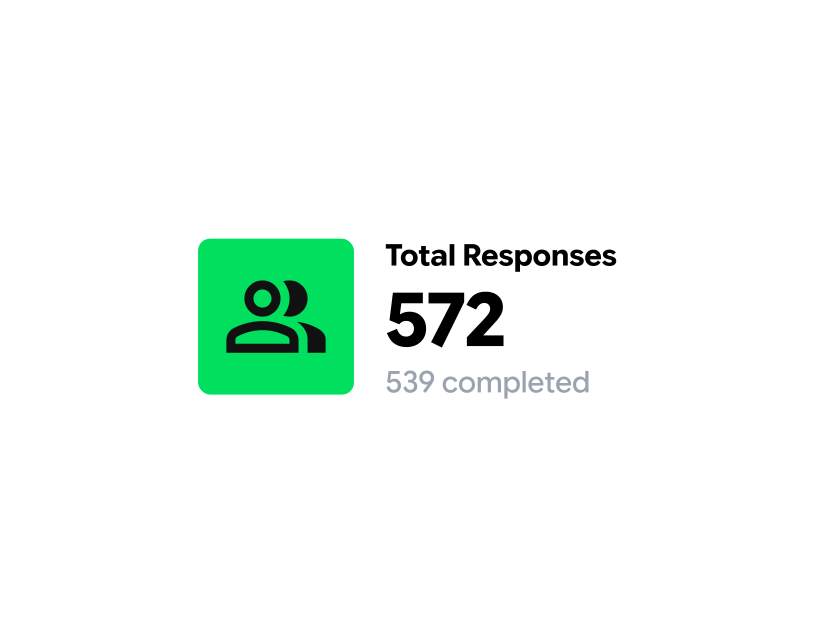
Your panel order runs against 30M+ verified respondents across 127 countries. Cost is confirmed before you launch — enter your target sample size and see the total before committing.
Read your results.
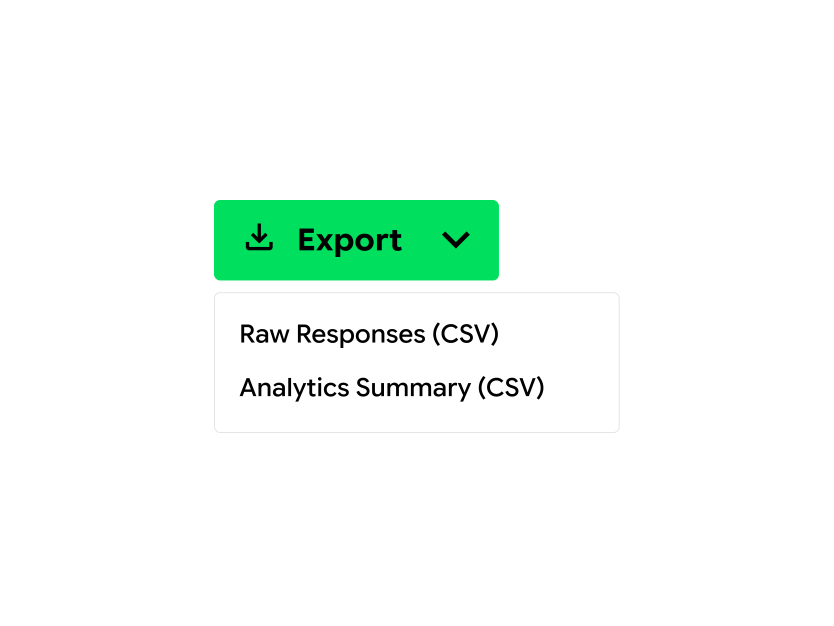
Per-question analytics, AI-generated pattern detection, and individual response browsing. Export raw data as CSV or XLSX. The purchase intent and appeal cross-tabs are usually the most useful output: if appeal is high and purchase intent is low, you likely have a nice-to-have rather than a must-have. That's the most common finding — and the most important one to catch early.
Why the question order matters: problem framing before concept reveal. If you show respondents your concept before establishing the problem context, they evaluate the idea in isolation — not relative to the real pain they experience. The template sequence sets this up correctly.


Simple pricing. No surprise invoices.



Common questions
What's the difference between idea validation and concept testing?
Idea validation is the goal — finding out if people want what you're building. Concept testing is the methodology used to get there: you present a structured description of your concept and measure appeal, uniqueness, and purchase intent. When you run an idea validation study on SegmentOS, you're running a concept test. The two terms describe the same study from different angles.
What purchase intent score counts as a green light?
There's no universal threshold, but a common benchmark for early-stage concept testing: "very likely" or "extremely likely" to purchase at 20–25% or more of your target market is a meaningful positive signal. Appeal alone doesn't tell you enough — focus on purchase intent, and especially on the gap between "appealing" and "likely to buy." A large gap between those two scores usually means nice-to-have, not must-have.
How many respondents do I need?
For broad B2C concepts, 300–500 respondents gives you statistically reliable results at a 95% confidence level. For narrow niches or B2B segments, 100–200 is often sufficient — but you'll need tight screeners to make sure you're reaching the right people. Use our free sample size calculator to get the exact number for your audience.
Can I run this study before the product exists?
Yes — that's the point. You describe the concept in two to three sentences and measure consumer response. You don't need a prototype, a landing page, or an MVP. A clear description of the problem and the proposed solution is enough to get meaningful signal.
What if my results are negative?
Negative results at this stage are the best possible outcome. They cost $200–$400 in panel time. Finding out the market doesn't want what you're building after six months of development costs significantly more. If purchase intent is low, the data will tell you why: low appeal means the concept doesn't resonate; high appeal with low purchase intent means they don't see it as a must-have. Either answer points you toward what to change.
What's an idea validation framework?
A validation framework is the sequence of questions you ask — in order — to determine whether a business idea has real market demand. The core sequence: (1) does the problem exist and is it painful? (2) does your concept address it in a way that's appealing and distinct? (3) would they actually pay for it? (4) at what price? Running these questions in order, with a qualified respondent sample, is what turns a hunch into a signal.