Pricing Validation Study. Find the price range your market will actually accept.
Run a Van Westendorp Price Sensitivity study with real consumers. Map the acceptable price range, identify where you start losing buyers, and price your product with data — not a guess. 30M+ verified respondents across 127 countries. From $0.73/response.
A pricing validation study doesn't ask "what would you pay?" — that single-question approach consistently overestimates willingness to pay. The Van Westendorp Price Sensitivity Meter asks four calibrated questions and maps four price points that together define your pricing window:
The acceptable price range
The range between "so cheap I'd question the quality" and "expensive enough that I'd seriously reconsider." This is the window where most of your market will buy without friction.
The optimal price point
The price where equal numbers of respondents find it "cheap" and "expensive" — neither suspiciously low nor uncomfortably high. It's often not the midpoint of the acceptable range.
The point of marginal cheapness
Below this price, the low price itself becomes a quality signal. Some consumers would rather pay more for the same product.
The point of marginal expensiveness
Above this price, you start losing buyers fast. Volume drops more steeply than revenue gains.
How it works


Set your audience.
Target by age, gender, location, and category. For pricing research, the screener matters: you want people who have actually purchased in your category, not people who'd never be in your market regardless of price. Screener included in the template.ge, gender, location, product category, and purchase behavior. For a brand study, you typically want category buyers — people who've bought in your market in the last 3–6 months.

Launch the study.
The Pricing Study template uses the Van Westendorp Price Sensitivity Meter — four questions, designed to be asked in sequence. The order matters: how you ask price questions affects how respondents interpret the reference points. The template handles the sequence automatically. Under 2 minutes from template to live.
Collect responses.
Panel runs against 30M+ verified respondents in 127 countries. Cost is confirmed before you launch — enter your target sample size and see the total before committing.
Read your results.
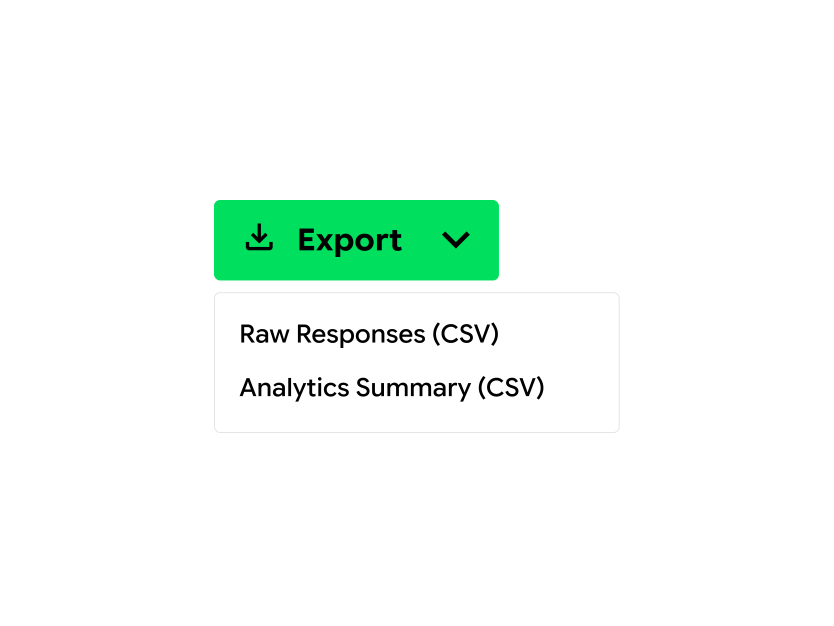
Per-question distributions, cumulative frequency curves, and AI-generated insight summaries. The key output is the PSM chart — four price curves plotted together — from which you read the Acceptable Price Range, Optimal Price Point, and Points of Marginal Cheapness and Expensiveness. Export raw data as CSV or XLSX.
The methodology note: Van Westendorp bypasses direct willingness-to-pay bias because respondents answer relative to reference points ("too cheap to trust" vs. "too expensive to buy") rather than anchoring on a single number. The four intersecting curves produce a price window, which is more useful for actual pricing decisions than a single estimate.
A typical pricing validation study with 300–500 respondents runs approximately $220–$500 in panel costs, depending on category targeting. B2B pricing studies with narrower targeting criteria cost more per response. Cost is shown before you launch.


Simple pricing. No surprise invoices.



Common questions
What is the Van Westendorp Price Sensitivity Meter?
A four-question pricing research methodology developed by Dutch economist Peter Van Westendorp in 1976. Instead of asking respondents what they'd pay directly — which introduces anchoring bias — it maps price perception across four reference points: too cheap to trust, acceptable bargain, getting expensive, and too expensive to buy. Plotting these four responses as cumulative frequency curves produces the Acceptable Price Range and the Optimal Price Point for your market.
How is this different from just asking "what would you pay?"
A single willingness-to-pay question consistently produces inflated estimates. Respondents anchor on aspirational prices rather than real purchase thresholds. The Van Westendorp method sidesteps this by asking about price ranges, not a specific number, and by triangulating across four distinct reference points. The output is a price window — which is more useful for real pricing decisions than a single number that's probably too high.
How many respondents do I need for a pricing study?
For a B2C product in a mass-market category, 300–500 respondents gives you stable cumulative frequency curves. For narrow niches, B2B, or when you want to compare pricing across segments, you need enough respondents per segment to be meaningful — typically 200+ per segment.
Can I run this study before the product exists?
Yes. You describe the product in a sentence or two before the Van Westendorp questions. The methodology was designed for early-stage pricing research — you don't need a prototype or a live product to get reliable price sensitivity data.
What if I have multiple price tiers or packages to test?
You can run separate studies for each tier, or use answer piping to show respondents different concept descriptions before each Van Westendorp sequence. For complex packaging decisions with 3+ tiers where features and price trade off against each other, a Conjoint Analysis study is more appropriate — respondents evaluate feature bundles at different price points simultaneously, rather than evaluating each price point in isolation.
Does the study work for B2B pricing?
Yes, though B2B pricing studies require narrower audience targeting and typically smaller sample sizes. B2B panel pricing is higher per response because the targeting criteria are more specific (industry, company size, job role). Cost is confirmed before launch — no surprises.