Content Validation Study. Test your copy before you pay to run it.

Run a message testing study on headlines, ad copy, landing page messaging, or campaign concepts — with real consumers from your target market. Find out what's clear, what's credible, and what's getting lost before you commit the budget. 30M+ verified respondents across 127 countries. From $0.73/response.

30M+ panel · 127 countries · From $0.73/response

30M+ panel · 127 countries · From $0.73/response

What you learn from a content validation study

What you learn from a content validation study

What you learn from a content validation study

Consumer feedback on content lives and dies on specificity. A content validation study measures five things that creative intuition won't:

Message clarity

Do consumers understand what you're saying? Not what you meant to say — what they actually take away. This is where most copy fails: the message is clear to the team that wrote it and opaque to the people it's supposed to reach.

Message appeal

Do they care? Clarity isn't enough if the message doesn't move them. Appeal scores show how compelling the message is to the people who actually understood it.

Credibility

Do they believe it? A claim that sounds too good gets discounted regardless of clarity. Credibility scores surface which messages land as believable vs. which ones are triggering skepticism before anyone clicks.

Brand connection

Does the message link back to your brand? Strong copy isn't just clear and credible — it creates an association. This metric shows whether the message is building brand memory or floating unattached to anything you own.

Distinctiveness

Does this sound like something they've heard before? If your positioning is identical to a competitor's, consumers won't register the difference. Uniqueness ratings catch generic positioning before you spend the media budget on it.

Who runs these studies

Who runs these studies

Who runs these studies

Who runs these studies

Running the creative through a validation study before you buy media is the cheapest insurance in marketing. The cost of a 300-person study is a fraction of a week of wasted paid media.

Marketing teams preparing to commit budget to a campaign.

You're not A/B testing between two live versions — you're deciding which direction to go before you build the page.

Founders and early-stage teams testing homepage positioning statements and taglines.

Instead of defending preferences in a room, you bring consumer data. "Here's what 400 people from your target market actually responded to" is a different kind of recommendation.

Brand consultants and creative agencies presenting multiple concepts to a client.

validating email subject lines, feature names, onboarding copy, or in-app messaging before shipping. The same methodology that works for ad copy works for any language consumers encounter.

CX and product teams

How it works

BG

Set your audience.

Target by demographics, purchase behavior, and category. For content testing, you want consumers who match your actual target buyer — not a general population sample. The screener filters for the right people before they see your content.

BG

Launch the study.

Use the Ad Testing template — pre-built to measure recall, message clarity, credibility, and brand impact. Show up to 3 content concepts in a single study with built-in respondent rotation. Screener and attention check included. Under 2 minutes from template to live.
BG

Collect responses.

Panel runs against 30M+ verified respondents in 127 countries. Cost is confirmed before you launch — enter your target sample size and see the total before committing.
BG

Read your results.

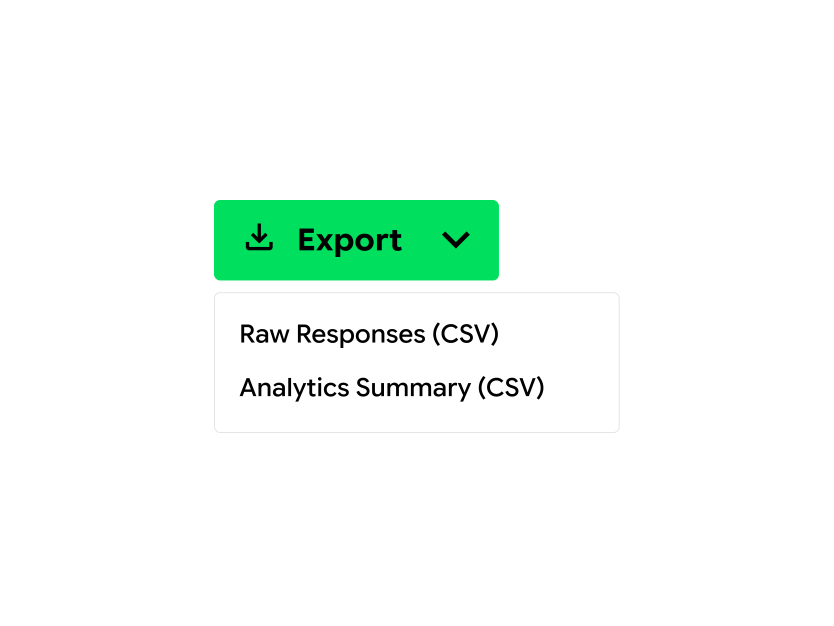
Per-question analytics, side-by-side concept comparison, and AI-generated pattern detection. The comparison view is the most useful output when you're testing multiple concepts: clarity, appeal, and credibility scores plotted against each other, with winner signals. Export as CSV or XLSX.

TOn testing multiple concepts: the template uses monadic design — each respondent sees only one concept. This prevents order effects from contaminating scores. It's the methodologically correct way to compare creative options, and it's built into how the template distributes respondents across concepts.


A typical content validation study with 300 respondents per concept runs approximately $220–$350 per concept in panel costs. Testing 3 concepts with 200 respondents each runs approximately $440–$600 total, depending on targeting. Cost is confirmed before you launch.

What's in the Ad Testing template

The template runs ~10 questions per concept. Here's the structure:


Screener"Which of the following product categories have you purchased in the last 3 months?" Routes out respondents outside your target market before they see your content.


Concept exposure — Display block showing your ad, headline, landing page copy, or message. Supports text, image, or both.


Message clarity"After reading this, what do you think this product/brand is about?" Open text. You're reading for comprehension — does their interpretation match your intent? Mismatches here tell you the message needs work before anything else.


Unprompted recall"What, if anything, stands out to you about this message?" Open text. What captures attention vs. what disappears.


Appeal"How appealing is this message to you?" 5-point scale.


Credibility"How believable is the message in this ad?" 5-point scale.


Brand connection"How well does this ad reflect what you'd expect from a brand in this category?" 5-point scale.


Distinctiveness"Have you seen messaging like this before?" Binary + follow-up. Catches generic positioning before you launch it.


Purchase impact"Does seeing this make you more or less likely to consider this brand?" 5-point scale.


Attention check — Built in. Auto-disqualifies inattentive respondents before they reach your results.


Template available on the Pro plan ($79/month). 4 free templates available on the Free plan.

Esteban Corrales, Chief Analytics Officer of SegmentOS.

What's in the Ad Testing template

The template runs ~10 questions per concept. Here's the structure:


Screener"Which of the following product categories have you purchased in the last 3 months?" Routes out respondents outside your target market before they see your content.


Concept exposure — Display block showing your ad, headline, landing page copy, or message. Supports text, image, or both.


Message clarity"After reading this, what do you think this product/brand is about?" Open text. You're reading for comprehension — does their interpretation match your intent? Mismatches here tell you the message needs work before anything else.


Unprompted recall"What, if anything, stands out to you about this message?" Open text. What captures attention vs. what disappears.


Appeal"How appealing is this message to you?" 5-point scale.


Credibility"How believable is the message in this ad?" 5-point scale.


Brand connection"How well does this ad reflect what you'd expect from a brand in this category?" 5-point scale.


Distinctiveness"Have you seen messaging like this before?" Binary + follow-up. Catches generic positioning before you launch it.


Purchase impact"Does seeing this make you more or less likely to consider this brand?" 5-point scale.


Attention check — Built in. Auto-disqualifies inattentive respondents before they reach your results.


Template available on the Pro plan ($79/month). 4 free templates available on the Free plan.

Esteban Corrales, Chief Analytics Officer of SegmentOS.

What's in the Ad Testing template

The template runs ~10 questions per concept. Here's the structure:


Screener"Which of the following product categories have you purchased in the last 3 months?" Routes out respondents outside your target market before they see your content.


Concept exposure — Display block showing your ad, headline, landing page copy, or message. Supports text, image, or both.


Message clarity"After reading this, what do you think this product/brand is about?" Open text. You're reading for comprehension — does their interpretation match your intent? Mismatches here tell you the message needs work before anything else.


Unprompted recall"What, if anything, stands out to you about this message?" Open text. What captures attention vs. what disappears.


Appeal"How appealing is this message to you?" 5-point scale.


Credibility"How believable is the message in this ad?" 5-point scale.


Brand connection"How well does this ad reflect what you'd expect from a brand in this category?" 5-point scale.


Distinctiveness"Have you seen messaging like this before?" Binary + follow-up. Catches generic positioning before you launch it.


Purchase impact"Does seeing this make you more or less likely to consider this brand?" 5-point scale.


Attention check — Built in. Auto-disqualifies inattentive respondents before they reach your results.


Template available on the Pro plan ($79/month). 4 free templates available on the Free plan.

Simple pricing. No surprise invoices.

One subscription. Survey builder, panel access, and research-grade methodology all included.

One subscription. Survey builder, panel access, and research-grade methodology all included.

Free

$0

5 surveys (lifetime)

500 responses/month

4 templates

Standard question types

Basic analytics

Restricted question library access

/month

$

29

Unlimited surveys

All 17 templates

All question types

Multi-language (27 languages)

Scoring & quotas

Remove branding

Full CSV/XLSX export

Full access to our question library

Pro

/month

$

79

Everything in Premium

Audience panel access

White-label

Priority support

Panel Responses from $0.73

B2C consumer responses from $0.73/response. B2B professional responses priced by targeting criteria. Exact cost shown before you launch — always.


No annual contract required. Cancel anytime.

Free

$0

5 surveys (lifetime)

500 responses/month

4 templates

Standard question types

Basic analytics

Restricted question library access

/month

$

29

Unlimited surveys

All 17 templates

All question types

Multi-language (27 languages)

Scoring & quotas

Remove branding

Full CSV/XLSX export

Full access to our question library

Pro

/month

$

79

Everything in Premium

Audience panel access

White-label

Priority support

Panel Responses from $0.73

B2C consumer responses from $0.73/response. B2B professional responses priced by targeting criteria. Exact cost shown before you launch — always.


No annual contract required. Cancel anytime.

Free

$0

5 surveys (lifetime)

500 responses/month

4 templates

Standard question types

Basic analytics

Restricted question library access

/month

$

29

Unlimited surveys

All 17 templates

All question types

Multi-language (27 languages)

Scoring & quotas

Remove branding

Full CSV/XLSX export

Full access to our question library

Pro

/month

$

79

Everything in Premium

Audience panel access

White-label

Priority support

Panel Responses from $0.73

B2C consumer responses from $0.73/response. B2B professional responses priced by targeting criteria. Exact cost shown before you launch — always.


No annual contract required. Cancel anytime.

Free

$0

5 surveys (lifetime)

500 responses/month

4 templates

Standard question types

Basic analytics

Restricted question library access

/month

$

29

Unlimited surveys

All 17 templates

All question types

Multi-language (27 languages)

Scoring & quotas

Remove branding

Full CSV/XLSX export

Full access to our question library

Pro

/month

$

79

Everything in Premium

Audience panel access

White-label

Priority support

Panel Responses from $0.73

B2C consumer responses from $0.73/response. B2B professional responses priced by targeting criteria. Exact cost shown before you launch — always.


No annual contract required. Cancel anytime.

Common questions

What types of content can I test?

ny language or visual content consumers will see: ad headlines, taglines, campaign concepts, landing page copy, email subject lines, feature names, onboarding messages, social media copy, packaging text. If it's consumer-facing language, you can test it before it's live.

What's the difference between content validation and A/B testing?

A/B testing tells you which version performs better after you've committed to running both — at real traffic volumes, which costs money and time. Content validation tells you what's likely to work before you build or launch anything. You validate first to narrow the options, then A/B test the winner to optimize. They're sequential, not competing methods.

Can I test multiple concepts in one study?

Yes. The template supports monadic testing — each respondent sees only one concept, which prevents order effects from contaminating scores. You can test up to 3 concepts in a single study, distributed across separate respondent groups. This is the methodologically correct approach to comparing creative options.

How many respondents do I need?

For testing a single concept, 200–300 respondents gives you statistically reliable clarity, appeal, and credibility scores. For comparing multiple concepts monadically, you need the per-concept sample multiplied by the number of concepts — 200 per concept at minimum. Use our [sample size calculator →] to get the exact number for your study.

What if I want to test copy but don't have final visuals yet?

You can test text-only concepts. The platform supports text block displays alongside the question sequence. Many of the most useful content tests use a headline and two to three supporting lines of copy, no image. What matters is that respondents can read and respond to the message you're trying to validate — not that the creative is finished.

Can I use this to test messaging in multiple languages?

Yes. SegmentOS supports 27 languages with AI-powered one-click translation. If you're validating content for a Spanish-speaking market, you can run the study in Spanish with Spanish-speaking respondents from your target country. AI translation covers the study interface; you supply the content you want to test in the target language.