Concept Testing Study. Find out if your concept has what it takes before you build it.

Appeal, uniqueness, purchase intent, and price expectations — measured with real consumers from your target market. Screener and attention check included. From $0.73/response.

30M+ panel · 127 countries · From $0.73/response

30M+ panel · 127 countries · From $0.73/response

What a concept testing study tells you

What a concept testing study tells you

What a concept testing study tells you

A concept test puts your idea in front of real consumers — before you've built anything, spent money on it, or committed to a direction — and asks them to evaluate it directly.


Four things it tells you:

Appeal

Does the concept interest your target consumer? Not "is it a good idea in the abstract" — does the specific person you'd sell it to want it? Appeal measures the initial hook.

Uniqueness

Does the concept feel different from what's already available? Consumers who find a concept compelling but not unique are telling you the market is already covered. That's useful before you enter it.

Purchase intent

If this product were available today at a realistic price, how likely would your target consumer be to buy it? Purchase intent is the closest proxy for real demand that concept research produces.

Price expectations

What price does the target consumer expect this type of product to carry? This gives you an early read on pricing before you run a full Van Westendorp study.

Who runs concept testing studies

Who runs concept testing studies

Who runs concept testing studies

Who runs concept testing studies

evaluating two or three directions before committing engineering resources to one. Run a concept test on each direction — the data tells you which one the market wants, not which one the team likes.

Product teams

validating a new product idea before the next funding round. Concept testing data is more persuasive to investors than founder conviction.

Startup founders

launching a new product, sub-brand, or category extension. Before you invest in packaging, retail placement, and a campaign, find out whether the concept lands with the target consumer.

Brand managers

running an internal pipeline of ideas. Concept testing is the filter that separates the ones worth developing from the ones worth dropping early.

Innovation teams

How it works

BG

Set your audience.

Target the specific consumer profile your concept is built for — the right category, demographics, and purchase behavior. Concept testing with the wrong audience produces misleading results. If your concept is for frequent category buyers, screen for that.

BG

Launch the study.

Use the Concept Testing template — built with the four core concept evaluation metrics, a screener to qualify respondents, and an attention check. Present your concept as a brief description: product name, what it does, and the core benefit. Under 2 minutes from template to live.
BG

Collect responses.

The panel delivers results from 30M+ verified respondents. 150–300 respondents per concept gives you reliable data. If you're testing multiple concepts, use a monadic design — each respondent evaluates one concept only. Cost confirmed before you launch.
BG

Read your results.

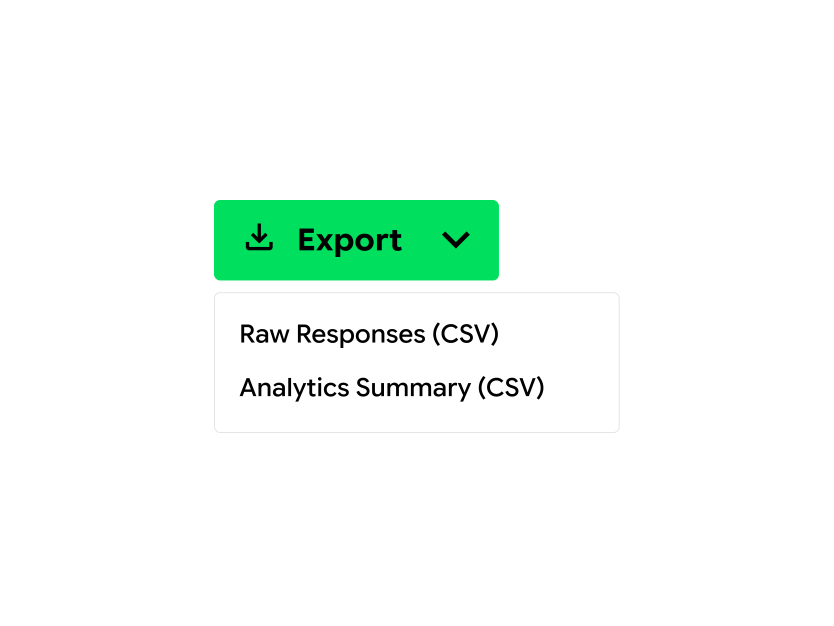
Per-question analytics break down appeal, uniqueness, purchase intent, and price expectations by response distribution. If you're testing multiple concepts, compare scores side by side in the exported data.

Why monadic design matters: showing respondents two concepts in the same survey creates comparison effects — they'll rate the second concept relative to the first, not on its own merits. In professional concept research, each respondent sees one concept. You split your sample between concepts and compare results in analysis, not in the survey itself.


A standard concept test with 200 respondents per concept runs approximately $150–$200 in panel costs. Testing two concepts? Budget $300–$400. Run each as a separate study with different respondents.


Launch your concept testing study → [Start free — no credit card required]

What's in the Concept Testing template

The template runs approximately 10 questions. Core structure:

Screener"Which of the following product categories have you purchased in the last 3 months?" Routes out respondents who don't buy in your category. Results from non-buyers aren't useful for concept validation.

Concept exposure — Present your concept as a text block (product name + description + core benefit). Respondents read the concept before answering evaluation questions.

Appeal"How appealing do you find this concept?" 5-point scale from Not at all appealing to Extremely appealing. This is your headline metric — the number you lead with in readouts.

Uniqueness"How different does this concept feel from other products currently available?" 5-point scale. High appeal + low uniqueness = crowded market. High appeal + high uniqueness = potential whitespace.

Purchase intent"If this product were available today, how likely would you be to purchase it?" 5-point scale (Definitely would not buy to Definitely would buy). The most scrutinized number in concept research.

Price expectation"What price would you expect to pay for a product like this?" Open numeric entry. Gives you an early price signal before a full Van Westendorp study.

Open feedback"What, if anything, would you change about this concept?" Optional but useful for diagnosing why appeal is lower than expected.

Attention check — Built in, auto-disqualifies inattentive respondents before their responses reach your results.

Template available on the Pro plan ($79/month). Free plan includes 4 templates — check the free templates if you haven't launched yet.

Esteban Corrales, Chief Analytics Officer of SegmentOS.

What's in the Concept Testing template

The template runs approximately 10 questions. Core structure:

Screener"Which of the following product categories have you purchased in the last 3 months?" Routes out respondents who don't buy in your category. Results from non-buyers aren't useful for concept validation.

Concept exposure — Present your concept as a text block (product name + description + core benefit). Respondents read the concept before answering evaluation questions.

Appeal"How appealing do you find this concept?" 5-point scale from Not at all appealing to Extremely appealing. This is your headline metric — the number you lead with in readouts.

Uniqueness"How different does this concept feel from other products currently available?" 5-point scale. High appeal + low uniqueness = crowded market. High appeal + high uniqueness = potential whitespace.

Purchase intent"If this product were available today, how likely would you be to purchase it?" 5-point scale (Definitely would not buy to Definitely would buy). The most scrutinized number in concept research.

Price expectation"What price would you expect to pay for a product like this?" Open numeric entry. Gives you an early price signal before a full Van Westendorp study.

Open feedback"What, if anything, would you change about this concept?" Optional but useful for diagnosing why appeal is lower than expected.

Attention check — Built in, auto-disqualifies inattentive respondents before their responses reach your results.

Template available on the Pro plan ($79/month). Free plan includes 4 templates — check the free templates if you haven't launched yet.

Esteban Corrales, Chief Analytics Officer of SegmentOS.

What's in the Concept Testing template

The template runs approximately 10 questions. Core structure:

Screener"Which of the following product categories have you purchased in the last 3 months?" Routes out respondents who don't buy in your category. Results from non-buyers aren't useful for concept validation.

Concept exposure — Present your concept as a text block (product name + description + core benefit). Respondents read the concept before answering evaluation questions.

Appeal"How appealing do you find this concept?" 5-point scale from Not at all appealing to Extremely appealing. This is your headline metric — the number you lead with in readouts.

Uniqueness"How different does this concept feel from other products currently available?" 5-point scale. High appeal + low uniqueness = crowded market. High appeal + high uniqueness = potential whitespace.

Purchase intent"If this product were available today, how likely would you be to purchase it?" 5-point scale (Definitely would not buy to Definitely would buy). The most scrutinized number in concept research.

Price expectation"What price would you expect to pay for a product like this?" Open numeric entry. Gives you an early price signal before a full Van Westendorp study.

Open feedback"What, if anything, would you change about this concept?" Optional but useful for diagnosing why appeal is lower than expected.

Attention check — Built in, auto-disqualifies inattentive respondents before their responses reach your results.

Template available on the Pro plan ($79/month). Free plan includes 4 templates — check the free templates if you haven't launched yet.

Simple pricing. No surprise invoices.

One subscription. Survey builder, panel access, and research-grade methodology all included.

One subscription. Survey builder, panel access, and research-grade methodology all included.

Free

$0

5 surveys (lifetime)

500 responses/month

4 templates

Standard question types

Basic analytics

Restricted question library access

/month

$

29

Unlimited surveys

All 17 templates

All question types

Multi-language (27 languages)

Scoring & quotas

Remove branding

Full CSV/XLSX export

Full access to our question library

Pro

/month

$

79

Everything in Premium

Audience panel access

White-label

Priority support

Panel Responses from $0.73

B2C consumer responses from $0.73/response. B2B professional responses priced by targeting criteria. Exact cost shown before you launch — always.


No annual contract required. Cancel anytime.

Free

$0

5 surveys (lifetime)

500 responses/month

4 templates

Standard question types

Basic analytics

Restricted question library access

/month

$

29

Unlimited surveys

All 17 templates

All question types

Multi-language (27 languages)

Scoring & quotas

Remove branding

Full CSV/XLSX export

Full access to our question library

Pro

/month

$

79

Everything in Premium

Audience panel access

White-label

Priority support

Panel Responses from $0.73

B2C consumer responses from $0.73/response. B2B professional responses priced by targeting criteria. Exact cost shown before you launch — always.


No annual contract required. Cancel anytime.

Free

$0

5 surveys (lifetime)

500 responses/month

4 templates

Standard question types

Basic analytics

Restricted question library access

/month

$

29

Unlimited surveys

All 17 templates

All question types

Multi-language (27 languages)

Scoring & quotas

Remove branding

Full CSV/XLSX export

Full access to our question library

Pro

/month

$

79

Everything in Premium

Audience panel access

White-label

Priority support

Panel Responses from $0.73

B2C consumer responses from $0.73/response. B2B professional responses priced by targeting criteria. Exact cost shown before you launch — always.


No annual contract required. Cancel anytime.

Common questions

What is concept testing in market research?

Concept testing is a quantitative research method that measures consumer reaction to a new product idea — before the product is built. You present a concept description (what the product is, what it does, what the core benefit is) to a sample of your target consumers and measure appeal, uniqueness, and purchase intent. It's the standard research method for filtering which product ideas are worth developing and for diagnosing which elements of a concept need work.

How many respondents do I need for a concept test?

150–200 respondents per concept is sufficient for reliable results. If you're comparing two concepts head-to-head, you need 150–200 per concept — 300–400 respondents total, split between the two studies. More respondents give you tighter confidence intervals and more reliable subgroup analysis (e.g., appeal by age or gender), but the marginal return above 300 is small for most concept tests. Use our sample size calculator → to dial in the exact number.

What's the difference between monadic and sequential concept testing?

In monadic testing, each respondent evaluates one concept only. In sequential testing, each respondent evaluates multiple concepts in sequence. Sequential testing is faster and cheaper (fewer respondents) but introduces comparison effects — respondents rate each concept relative to what they just saw, not on its own merits. Monadic testing produces cleaner, more realistic data because each respondent comes to the concept fresh. The SegmentOS Concept Testing template is designed for monadic testing — one concept per study, independent respondents per concept.

What counts as a good concept test score?

Purchase intent is the most-watched metric, and the standard benchmark is the "top-2-box" score — the percentage of respondents who select "probably would buy" or "definitely would buy." A top-2-box of 30%+ is generally considered strong for a B2C consumer product in a competitive category. 20–30% is moderate — the concept has potential but needs work. Below 20% is a signal to rethink before investing. These benchmarks vary by category, so compare against your own historical tests when possible.

Can I test a concept that doesn't exist yet?

Yes — that's the point. You present a written description of the concept: what the product is, what it does, the core benefit or differentiator. It doesn't need to be a working prototype or even a mockup. A clear, specific one-paragraph description is sufficient for respondents to evaluate. The clearer and more concrete your concept description, the more reliable the scores.

What should I do if appeal is high but purchase intent is low?

This is the most common and instructive concept testing result. High appeal, low purchase intent usually means one of three things: the price expectation is higher than your target price (run a Van Westendorp study to find the acceptable range), the concept is compelling but the respondent doesn't personally need it (check your audience targeting), or there's a specific objection — check your open feedback question for patterns. Don't dismiss a high-appeal concept over low purchase intent without diagnosing the cause first.