A SegmentOS study of 1,017 US consumers, fielded June 2026. Results weighted to US Census age and gender targets.
Introduction: The Backlash Has a Price Tag
Through 2026, the question stopped being "should we add AI?" and became "where haven't we added it yet?" Brands raced to put AI into their ads, their support, their product copy, their hiring. What almost nobody measured is what the customer on the other side actually does about it.
SegmentOS asked 1,017 US consumers — directly, about their own behavior, not their opinions. The finding is a quiet but expensive verdict: people are penalizing brands for AI. They are canceling, switching, complaining, and refusing to pay. We call it the AI Tax — the hidden cost of shipping AI nobody asked for. And the brands paying it mostly don't know they're being charged.
Key Findings at a Glance
36% of US consumers have taken concrete action against a brand in the last 6 months specifically because it felt too AI-driven.
68% choose a "human-made" product over an identical "AI-made" one at the same price; just 10% choose AI.
54% say they would pay a price premium for human-made — the Human Premium.
45% have abandoned a purchase or support request rather than deal with an AI chatbot.
47% lose trust in a brand the moment they realize its copy was AI-written.
67% want a guaranteed human for medical advice; 61% for therapy; 59% for legal advice.
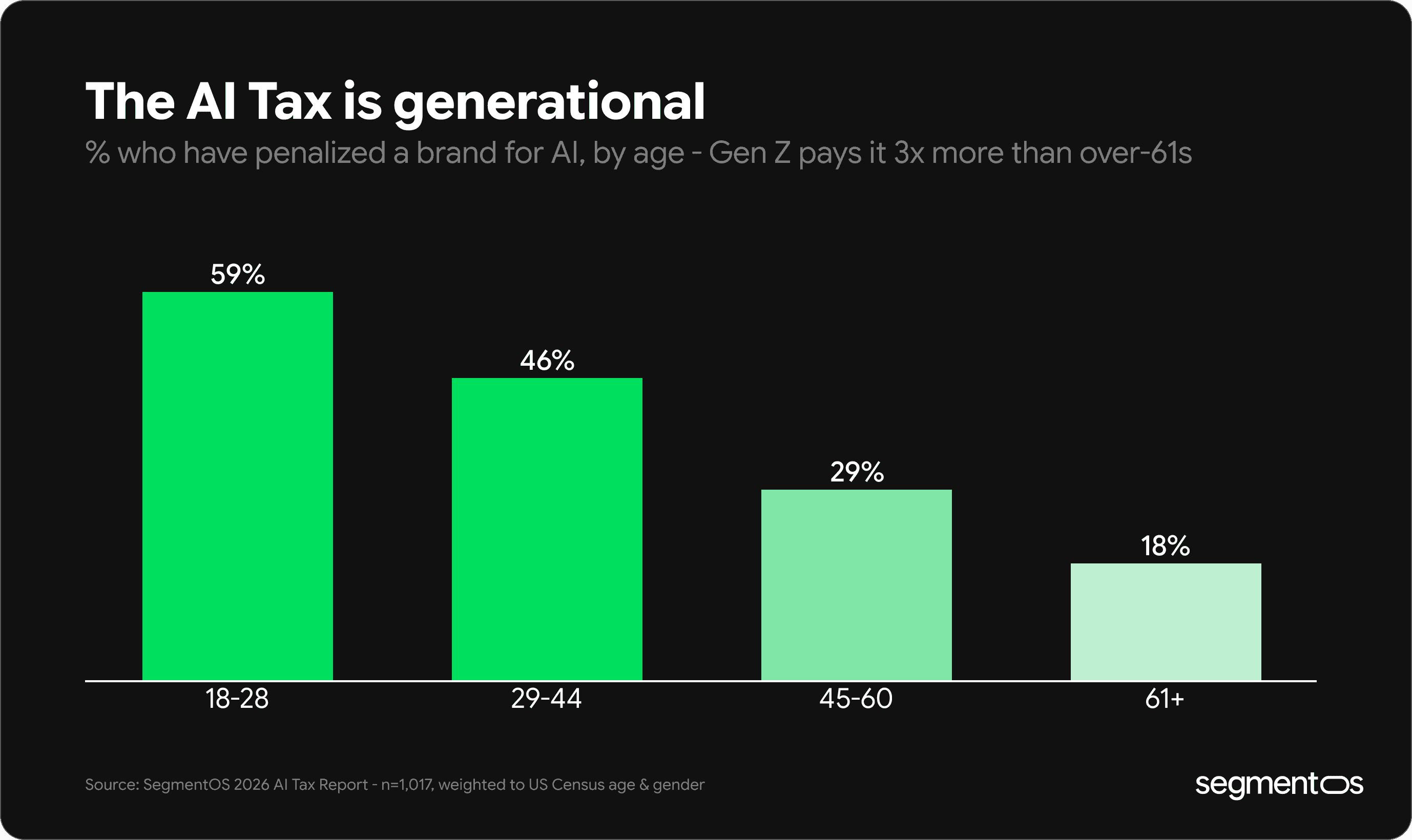
The backlash is generational: 59% of Gen Z has penalized a brand for AI, versus 18% of those 61+.
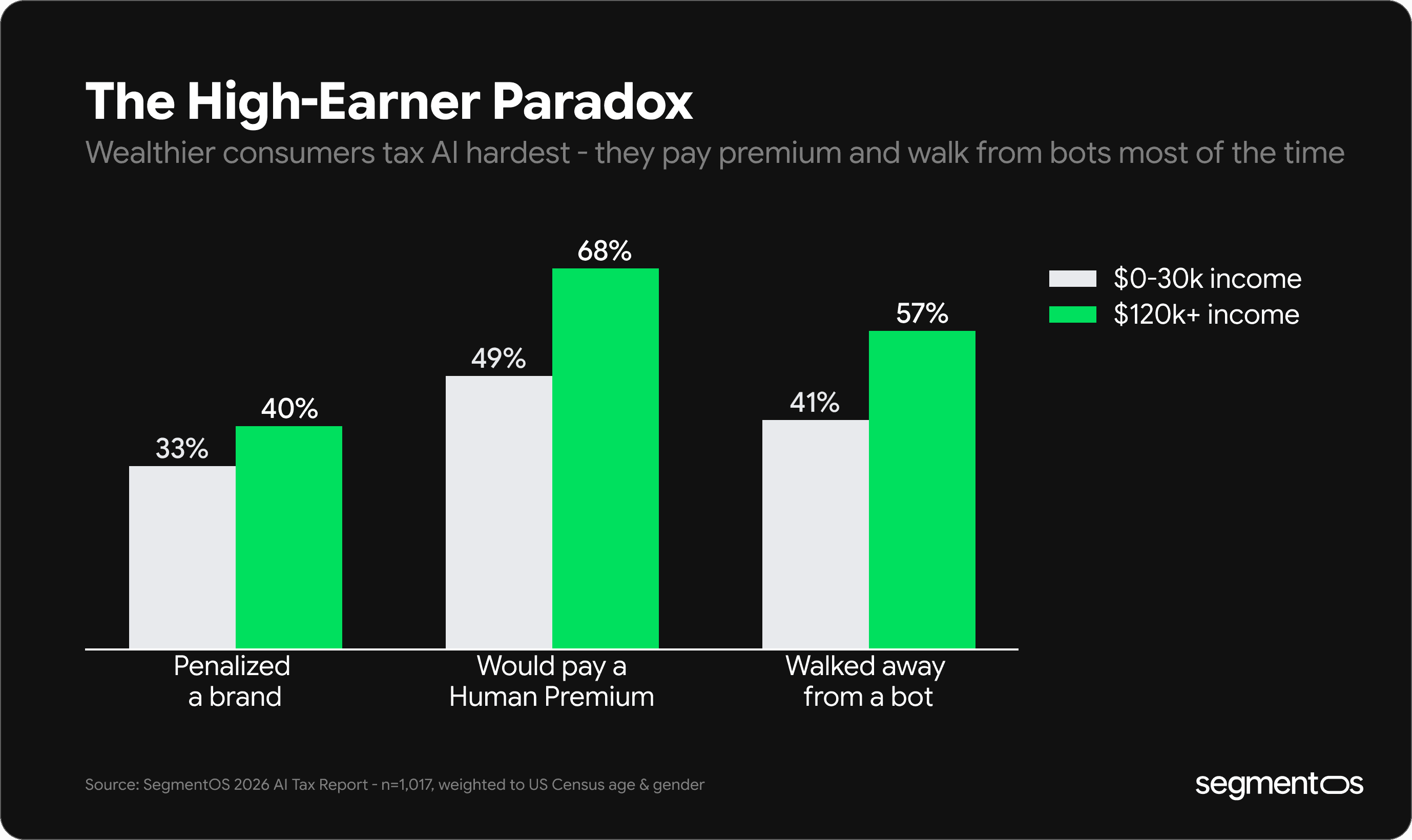
And it's wealth-weighted: high earners ($120k+) are the most likely to pay the Human Premium and walk away from bots.
1. The AI Tax: More Than a Third Have Punished a Brand for Using AI
In the last six months, 36% of consumers took a concrete action against a brand specifically because it felt too AI-driven. Not "felt annoyed" — did something:
18% unsubscribed or unfollowed
16% stopped buying from or canceled a brand
14% switched to a competitor
11% complained publicly on social or a review site
10% left a worse review or rating
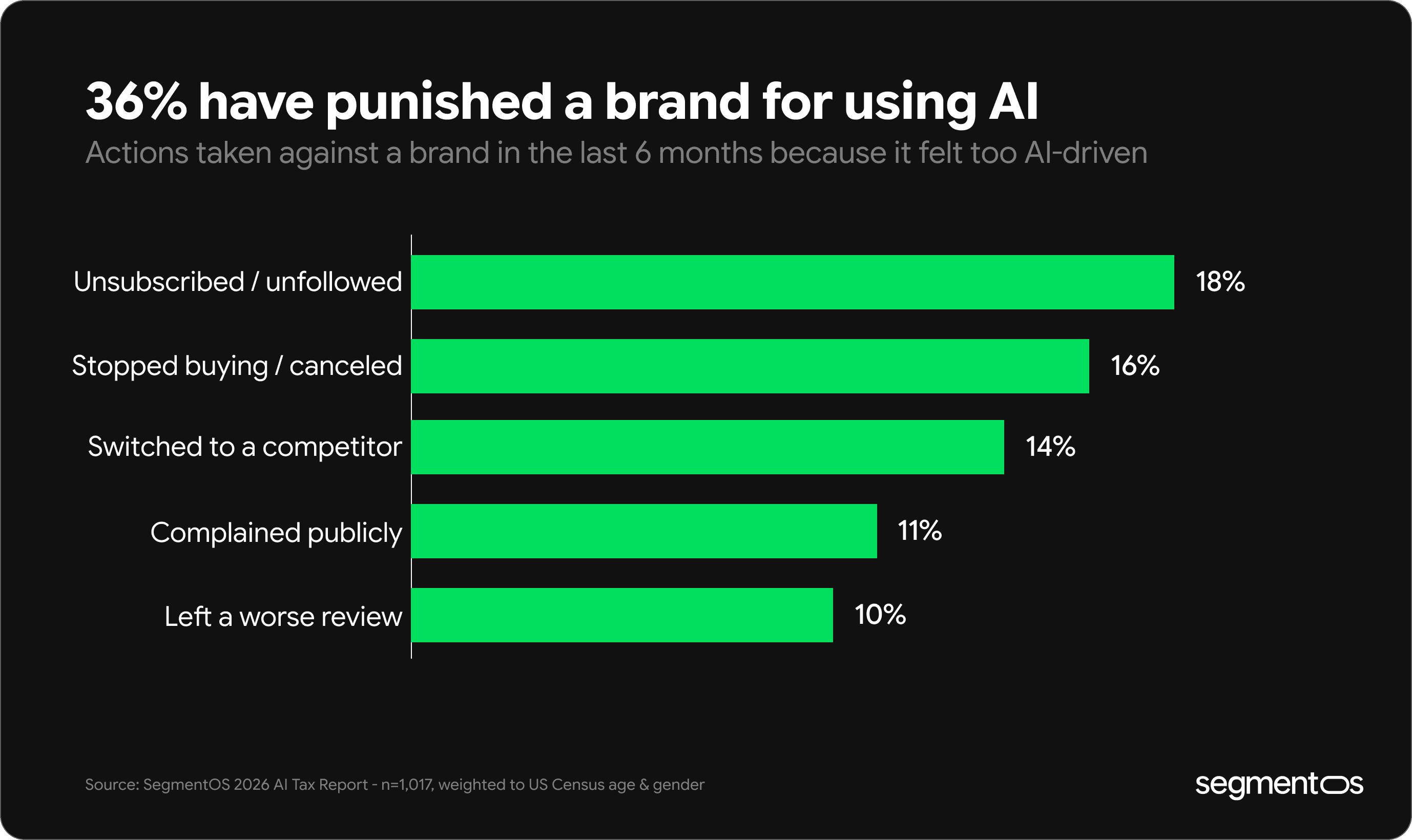
This is the AI Tax: real switching, real churn, real money, levied quietly by customers who never tell you why they left.
And it is sharply generational. The tax isn't paid evenly — it's paid by your future customers:
18–28 (Gen Z): 59% have penalized a brand for AI
29–44: 46%
45–60: 29%
61+: 18%
A brand optimizing for "AI-forward" is, by the numbers, optimizing against its youngest market — the one it can least afford to lose.
2. The AI Tax, in Dollars: Real Money Is Walking Out the Door
The AI Tax isn't only about clicks and cancellations — consumers attach dollar figures to it. Among those who could estimate, 47% say they've withheld at least some spending from brands over how they use AI in the past year. Across all respondents, 9% estimate they withheld $250 or more — and nearly a quarter said they "weren't sure," meaning the true figure is almost certainly understated.
No brand sees this on a dashboard. It doesn't show up as a complaint or a churn reason. It shows up as revenue that quietly never arrives — the defining feature of a tax you didn't know you were levying.
3. The High-Earner Paradox: Your Best Customers Tax You Hardest
The common assumption is that affluent, tech-forward consumers are the AI enthusiasts. The data says the opposite. Higher earners ($120k+ household income) are the most AI-resistant where it counts to the bottom line:
Behavior | $0–30k | $120k+ |
|---|---|---|
Have penalized a brand for AI | 33% | 40% |
Would pay a Human Premium | 49% | 68% |
Walked away from an AI chatbot | 41% | 57% |
The customers with the most money to spend are the most willing to spend it on human-made — and the most willing to walk when they hit a bot. For premium and high-LTV brands, "AI-forward" may be a direct tax on the exact segment they most want to keep.
4. The Human Premium: ~7 in 10 Will Pick "Made by Humans" — Even at the Same Price
Given two identical products at the same price — one labeled "Made by humans," one "Made with AI" — the result wasn't close:
68% chose human-made
23% had no preference
Just 10% chose AI-made
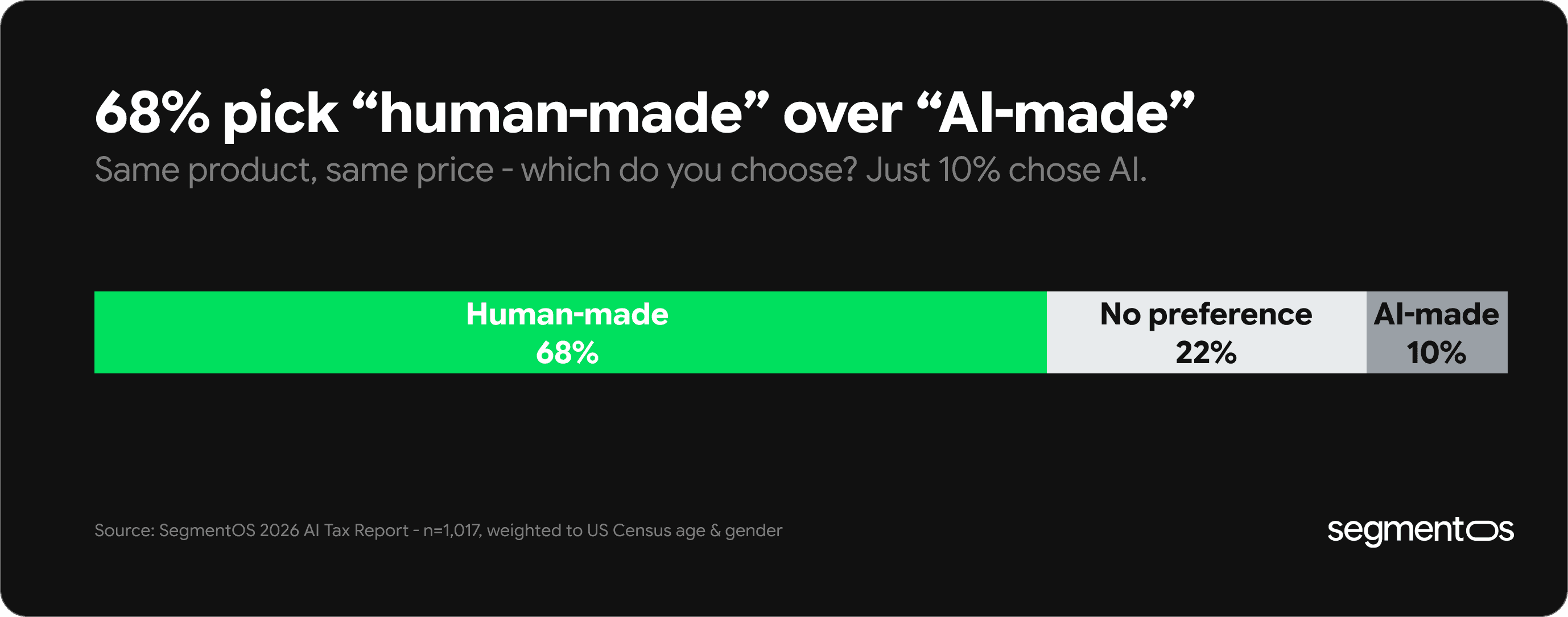
Because this is a forced choice at identical prices, it isn't people saying they value human work — it's people choosing it with no incentive to lie. And many will open their wallets for it: 54% say they'd pay more for a product explicitly marketed as human-made:
15% would pay 5% more
20% would pay 10% more
11% would pay 25% more
9% would pay 50% or more
Call it the Human Premium — and right now, almost no brand is charging it, because almost every brand is racing the other way. The preference is strongest among women (74% choose human-made vs. 61% of men), but it holds as a clear majority across every group we measured.
5. The Trust Discount: AI Copy Costs You Credibility on Contact
The moment consumers recognize AI wrote a brand's emails, ads, or copy, trust drops:
47% say their trust decreases (24% "a lot")
Only a small minority say it increases
This is the Trust Discount — an instant credibility penalty applied the second the AI is spotted. And it's spotted often: 23% say they've caught a brand using AI while passing the work off as human — "AI-washing." As one respondent put it after catching a brand faking it: "I blocked it and wouldn't do business with them again."
6. The Bot Wall: 45% Have Walked Away Rather Than Talk to a Chatbot
AI customer service was sold as a cost saving. For nearly half of customers, it's a cost: 45% have abandoned a purchase or a support request specifically because they got stuck with an AI chatbot instead of a human.
It's not a fringe irritation, either. When we asked, in open text, which AI use people would most want to ban from their lives, customer-service chatbots topped the list by a wide margin — named more than twice as often as any other category. The savings on support headcount are real. So is the Bot Wall — the line where a frustrated customer simply leaves, and never shows up in the support metrics because they never opened a ticket.
7. The No-Go Zones: Where Consumers Demand a Human, Full Stop
For some decisions, there is no premium high enough — people want a human guaranteed. Asked where they'd most want a guarantee that a human, not AI, was involved:
Domain | Want a human guaranteed |
|---|---|
Medical advice | 67% |
Therapy / mental health | 61% |
Legal advice | 59% |
Customer support | 48% |
Financial advice | 47% |
Job application screening | 43% |
Creative work | 36% |
News writing | 35% |
Dating profiles | 30% |
These are the No-Go Zones: high-stakes, high-trust domains where leading with AI doesn't save money — it forfeits the customer. As one respondent said: "Ban AI from therapy and mental health — empathy requires human care."
8. The Most-Resented AI: A Ranking
Not all AI is equally unwelcome. Asked which type of AI-generated content bothers them most, consumers pointed first at the places AI masquerades as fact or as a person:
Type of AI | Most-resented |
|---|---|
AI-generated news | 28% |
AI influencers / ads | 24% |
AI customer service | 20% |
AI "authentic" social posts | 12% |
AI dating profiles | 8% |
AI job applicants | 8% |
The pattern is clear: resentment spikes wherever AI is used to impersonate — to fake a person, a fact, or a relationship. Efficiency tools are tolerated; deception is taxed.
Sidebar — The Builder Blind Spot (directional; small builder sample, n = 47)
We also asked the founders, marketers, and product builders in our sample about the AI they ship. The numbers here are directional only given the small base — but they point at a striking disconnect:
Only about a quarter believe adding AI makes their product more attractive to customers — the rest say it makes no difference or makes things worse.
Roughly three in four say they added AI without testing whether customers wanted it with real users.
The most-cited reasons for adding AI were "competitors had it" and "investors expected it" — not "customers asked."
If even the people building AI features aren't convinced they help, and aren't testing demand, the AI Tax starts to look less like bad luck and more like a blind spot. (We're re-fielding a larger builder panel to confirm.)
Confessions from the Front Lines
Beyond the numbers, we asked consumers to describe their most absurd, infuriating, or telling AI encounters. A selection, lightly cleaned:
"I had a phone screen for a job which used an AI instead of a human. It couldn't understand nuance and wanted black-or-white answers for a gray situation."
"They claimed to design their graphics themselves — but it was AI."
"I work at a news station, and something online that turned out to be AI sent us on a story that wasn't worth our time."
"Brands trying to go viral, claiming an ad is real when something's off about it — the mouth movements, the eye movements."
"The chatbot pretends to understand, then gives generic responses. It wastes your time and creates frustration instead of real help."
"When AI is used to sell you something just to rip you off."
"I would ban it from listening to my private conversations."
Build a study, reach verified respondents in your market, and get answers back in days.
Everything a research team does. Without the research team.
With SegmentOS you can build the study, reach a verified audience, and get data you can actually trust. End to end, no research background required.


Data quality
Every study runs through device fingerprinting, speeding detection, attention checks, and screener disqualification.

Conclusion: AI Is Not Free
The promise of AI was efficiency. The data shows a bill attached — paid in churn, switched purchases, lost trust, withheld dollars, and abandoned carts. The brands being taxed rarely see the invoice, because customers don't file a complaint; they just leave. And the ones leaving are the ones brands most want to keep: the young, and the affluent.
The lesson isn't "never use AI." It's that AI is a feature like any other — and features should be validated with real customers before they ship, not after the backlash. The cheapest time to find out whether your AI helps or taxes you is before you build it.
Methodology: Online survey of 1,017 US adults who completed the questionnaire, fielded June 2026 via the SegmentOS panel. Respondents passed an in-survey attention check. Results are statistically weighted by age and gender to match US Census adult population estimates (2025); effective sample size 759, design effect 1.34. Subgroup figures (income, gender) are reported within group. Builder-segment findings (n=47) are directional and labeled as such. Full question wording available on request
Frequently Asked Questions (FAQ)
What is the "AI Tax"?
The AI Tax is the measurable penalty consumers impose on brands for using AI: canceling, switching to competitors, leaving worse reviews, or complaining. In this study, 36% of US consumers took at least one such action in the past six months.
Do consumers really prefer human-made products?
Yes. Given an identical product at the same price, 68% chose the one labeled "made by humans" and only 10% chose "made with AI." A majority (54%) said they would pay more for human-made — the "Human Premium."
Where do consumers most reject AI?
In high-stakes domains. 67% want a human guaranteed for medical advice, 61% for therapy and mental health, and 59% for legal advice — the "No-Go Zones."
Does AI customer service hurt business?
For many customers, yes. 45% have abandoned a purchase or support request because they were stuck with an AI chatbot instead of a human — and chatbots were the most commonly named AI people want to ban from their lives.
What should brands do about the AI Tax?
Validate AI features with real target customers before launching them, rather than adding AI because competitors or investors expect it. The data suggests many AI features are shipped on assumption, not demand.