Dating App Burnout Statistics 2026: 53% of Singles Have Opted Out

Dating App Burnout Statistics 2026: 53% of Singles Have Opted Out

Dating App Burnout Statistics 2026: 53% of Singles Have Opted Out

Written by

Written by

Patricio Luna

Patricio Luna

Published on

Published on

SegmentOS 2026 Love and Lies Report Cover featuring a woman looking skeptically at a laptop.

Introduction: The Efficiency Audit of Modern Romance

In early 2026, the digital dating landscape has officially shifted from a “connection economy” to a “vetting economy”. As dating app burnout reaches a decade-high, singles are no longer just swiping; they are auditing. SegmentOS leveraged its real-time market research infrastructure to analyze over 1,000 respondents, uncovering a radical move toward romantic austerity and AI-driven intimacy.

Want to check this for your own idea?

Free to start. No card needed.


1. The Great Opt-Out: Why 53% of Singles are Choosing AirFryers Over Apps

The most staggering finding of 2026 is the mass exodus from traditional dating platforms. 53.3% of singles (including those looking, not looking, and divorced) have officially “opted out”. Instead of digital swiping, these respondents report being in a “committed relationship with their AirFryer and a weighted blanket”.

  • Tinder as the “Casino”: 11% of users view the app as a high-stakes game where the algorithm house always wins.

  • Bumble as the “Job Interview”: 8.8% of users are exhausted by maintaining professional-level outreach standards for zero ROI.

  • The “Backdoor” Pivot: 14.1% of daters have moved to Instagram DMs for more organic vetting.


Bar chart showing Tinder, Bumble, Hinge, and Instagram rebranded as Casino, Job Interview, Fiction Section, and Backdoor.


2. Professional Proof of Stake: LinkedIn is the New First Date

In 2026, “chemistry” has become secondary to “career trajectory”. Before the first “hello,” 40.7% of daters perform a “Professional Audit” on LinkedIn.

  • The Male Perspective: 12.3% of men check a date’s professional credentials “every single time” to validate income and status.

  • Secondary Vetting: Women are 1.7x more likely than men to look up a date’s ex-partner on LinkedIn (9.7% vs 5.6%) to map relationship stability and social tiering.
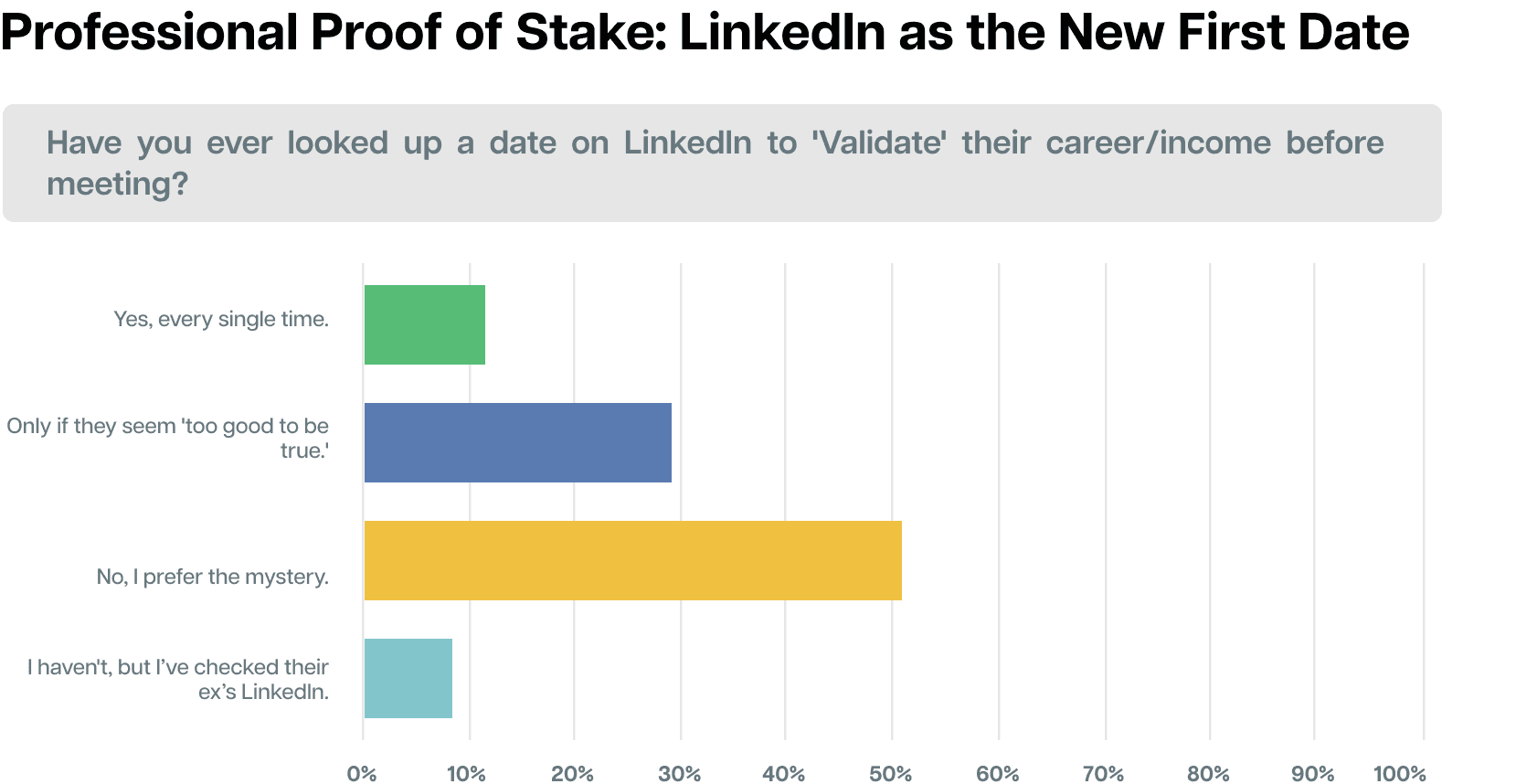

Graph showing the rise of LinkedIn vetting in the 2026 dating scene.


3. The Automation of Intimacy: AI Ethics and “Emotional Fraud”

As Large Language Models (LLMs) become ubiquitous, they are being used to “patch” romantic intimacy for speed. However, a profound generational rift has formed over the ethics of AI in romance.

  • The Gen Z Hardline: 35% of Gen Z (ages 18–26) categorize AI-written Valentine’s cards as “Emotional Fraud”.

  • The Summarization Scandal: 9.3% of all respondents admit to using AI to summarize long, emotional messages from partners to bypass “vibe-killing” fluff.

  • High-Earner Tech: Surprisingly, 50% of those earning over $100k view AI as a “romantic wingman” to help express feelings they can’t put into words.


4. Unit Economics: The Price of a Second Date

Daters are applying strict budget tiers to protect their time and capital.

  • The Coffee Audit: 38.1% of the general population and 43.8% of lower earners, now utilize a "Coffee Audit" (under $30 and 45 minutes) to minimize financial risk on a cold lead.

  • The Subscription Kill-Switch: 58.2% of respondents activate the "Kill Switch," revoking access to shared streaming accounts immediately upon a breakup.

  • Financial Secrets: 14% of Americans plan to take their credit card debt secrets "to their grave".


Pie chart illustrating the breakdown of date investment tiers: Coffee Audit, Standard Series A, and Moonshots.


5. Confessions from the Front Lines: The "Unhinged" Chronicles

The data isn't just numbers; it's a reflection of a chaotic dating ecosystem. Our proprietary open-ended responses revealed:

  • The Keychain Denier: A date who denied having children while their photos were on his keychain.

  • The Pop-Tart Baseline: A date that consisted entirely of a single bag of Pop-Tarts.

  • The Jailhouse Out: A respondent who used their partner's arrest as the "clean break" they needed to end the relationship.


Conclusion: Efficiency is the New Romance

The 2026 Love & Lies Report proves that as the friction of digital dating increases, users are responding with corporate-level vetting and automation. For brands and platforms, the message is clear: the era of the "unvetted" date is over.

Click here to read the full report

See our latest: The 2026 AI Tax Report: Why Consumers Are Quietly Punishing Brands for Using AI

What do you want to learn?

Say it in a sentence. SegmentOS writes the survey, and real people answer it.

Free to start. No card needed.

In this article

No headings found on page

Stop guessing. Ask your actual buyers.

Stop guessing. Ask your actual buyers.

Build a study, reach verified respondents in your market, and get answers back in days.

Free plan available · No card required

Frequently Asked Questions (FAQ)

Frequently Asked Questions (FAQ)

How common is dating app burnout in 2026?

Dating app burnout has reached a decade-high, with 53.3% of singles reporting they have officially "opted out" of digital swiping. This "Opt-Out" era is characterized by users choosing domestic comfort—often jokingly cited as a "committed relationship with an AirFryer"—over the low ROI of dating platforms.

Is it normal to check a date’s LinkedIn before meeting?

Yes, it is becoming a standard safety and status protocol. 40.7% of daters now perform a "Professional Audit" on LinkedIn to validate a potential partner's career and income. Interestingly, 12.3% of men report doing this "every single time," while women are 1.7x more likely than men to look up a date's ex-partner on the platform.

Is using AI to write love letters considered "cheating"?

The answer depends on who you ask. 35% of Gen Z categorize AI-written Valentine's cards as "Emotional Fraud". However, 50% of high earners ($100k+) actually view AI as a romantic tool that helps them express feelings they struggle to put into words.

What is the "Three Month Rule" for financial transparency?

The "Three Month Rule" is the threshold at which most daters feel comfortable sharing financial secrets. Among daters willing to be transparent, 63.4% believe the three-month mark (the "Commitment Stage") is the mandatory time to disclose student loans or credit card debt. However, 14% of Americans still plan to take their debt secrets "to the grave".

What is a "Coffee Audit" in dating?

A "Coffee Audit" is a low-risk first date strategy used by 38.1% of daters to protect their time and capital. It is defined as a date costing under $30 and lasting no more than 45 minutes. This strategy is most popular among lower earners, with 43.8% using it to minimize the financial risk of a "cold lead".

Insights & Updates

Explore articles, resources, and ideas where we share updates about the product, thoughts on technology, and lessons learned while building along the way.

Insights & Updates

Explore articles, resources, and ideas where we share updates about the product.